Jackery Explorer 1000 v2 vs Anker SOLIX C1000 Gen 2
Two boxes holding near enough the same battery: one is lighter and has a listing we could verify, the other is rated higher and refills quicker. Which of those you need depends on what you plug into it.
Buy the Jackery Explorer 1000 v2 if the weight matters, or if you want to order today from a listing we checked ourselves at $559. Buy the Anker SOLIX C1000 Gen 2 if you want the higher continuous output and the faster wall charge and are willing to confirm the listing yourself, because every bare-unit listing we found for it was a bundle, a two-pack or a different model. Against this plan the two land in the same place: each covers an efficient fridge in a cool kitchen for 8 hours, and neither covers a hard-working one, which needs a recharge, panels or a bigger battery partway through. Neither takes an add-on battery either, so whichever you pick is the capacity you keep.
The Amazon links on this page are affiliate links: if you buy through one we may earn a commission, at no extra cost to you. It does not change which units are picked. How that works.
| Model | Usable | Output | Short of worst case | Weight | Price | |
|---|---|---|---|---|---|---|
| The lighter one | Jackery Explorer 1000 v2 | 910 Wh | 1,500 W | 1,890 Wh | 24 lb | on Amazon |
| More output, faster charge | Anker SOLIX C1000 Gen 2 | 870 Wh | 2,000 W | 1,930 Wh | 25 lb | no verified listing |
| The one that refills | EcoFlow DELTA 3 Plus | 870 Wh | 1,800 W | 1,930 Wh | 28 lb | on Amazon |
Who this is for
You have the two tabs open and they look interchangeable: about a kilowatt-hour of battery each, the same peak rating, half a kilogram between them. The plan here is one refrigerator and nothing else on the circuit for 8 hours, because at this size the fridge is the whole load.
Leave if you need a hard-working fridge carried through that window without a refill; neither of these does it, and our home-backup page lists the 8 we track that clear the worst case. Check the badge before you order. The first-generation C1000 shares most of a name with the Gen 2 and is a different unit, with an expansion port and a built-in light Anker dropped from the Gen 2 for a smaller case. It sits in the table here for scale, not as a pick.
Side by side, from the makers’ own documents
“Not captured” means the maker’s page we captured does not state it: a gap in our record, not a zero, and never filled from a sibling model. “No verified listing” means no Amazon listing for the bare unit passed our identity check yet.
| Model | Battery | Continuous output | Peak output | Weight | Solar input | Expandable | Warranty | Chemistry | Verified listing |
|---|---|---|---|---|---|---|---|---|---|
| Jackery Explorer 1000 v2 | 1,070 Wh | 1,500 W | 3,000 W | 24 lb / 10.8 kg | 400 W | no (maker states not supported) | not captured | LiFePO4 | $559 |
| Anker SOLIX C1000 Gen 2 | 1,024 Wh | 2,000 W | 3,000 W | 25 lb / 11.3 kg | 600 W | not captured | not captured | not captured | no verified listing |
| Anker SOLIX C1000 | 1,056 Wh | 1,800 W | 2,400 W | 28 lb / 12.9 kg | 600 W | yes: Anker SOLIX BP1000 Expansion Battery (1056Wh) | 5 years | LiFePO4 | $560 |
| EcoFlow DELTA 3 Plus | 1,024 Wh | 1,800 W | 3,600 W | 28 lb / 12.5 kg | 1,000 W | documented by the maker (accessory not named on the page we captured) | 5 years | LiFePO4 | $719 |
Against the same plan
A refrigerator for an 8-hour working-day outage, sized on the harder end of every range.
Start with the instant the compressor kicks in. Running, this fridge sits between 100 and 700 watts and either box carries it easily; the test is the fraction of a second at the start, when the motor can ask from 600 to 2,900 watts. These two share the same peak rating and both cover the top of that range, so the start, which settles most pages here, does not settle this one.
The battery barely settles it either. An efficient fridge in a cool kitchen with the door mostly shut cycles about a fifth of the time and wants 160 watt-hours across the window; an old one in a warm kitchen, opened all day, runs half the time and wants 2,800. Neither maker publishes a usable-energy figure, so the site sizes from a conservative share of the nameplate; on that basis both land on clears the best case only. Of the 58 stations checked against this plan, 45 cover the easy end and 8 the hard one.
What is left is everything else. The Anker SOLIX C1000 Gen 2 has the higher continuous output, 2,000 watts against 1,500, refills from the wall faster and takes more solar. The Jackery Explorer 1000 v2 is the lighter one, and the one with a listing we could verify; every bare-unit listing we found for the Gen 2 was a bundle, a two-pack or another model, so no price is shown. Neither accepts an add-on battery, and neither has a warranty term in our record, though both makers publish one.
| Model | Covers the energy | Carries the running load | Clears the surge | Worst-case shortfall | Verdict |
|---|---|---|---|---|---|
| Jackery Explorer 1000 v2 | best case only | worst case | worst case | 1,890 Wh | Clears the best case only |
| Anker SOLIX C1000 Gen 2 | best case only | worst case | worst case | 1,930 Wh | Clears the best case only |
| Anker SOLIX C1000 | best case only | worst case | best case only | 1,902 Wh | Clears the best case only |
| EcoFlow DELTA 3 Plus | best case only | worst case | worst case | 1,930 Wh | Clears the best case only |
Where the energy goes, load by load
| Load | Hours | Running watts | Duty cycle | Energy | Share of worst case |
|---|---|---|---|---|---|
| Refrigerator/freezer | 8 | 100–700 | 20–50% | 160–2,800 Wh | 100% |
Energy = running watts × duty cycle × hours, at each end of the range. The right-hand end of every row is what the plan is sized on.
The lighter oneJackery Explorer 1000 v2
The lighter one
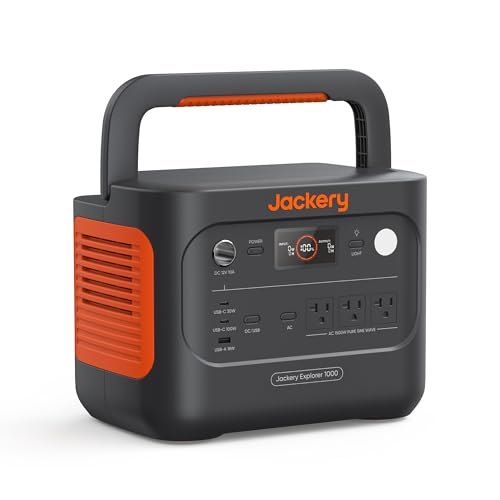
$559 at Amazon, September 16, 20261,070 Wh (910 usable)1,500 W continuous3,000 W peak24 lb
The Jackery Explorer 1000 v2 is the one you can act on this minute: a bare-unit listing at $559 that matches our record exactly, where the Gen 2's results are bundles and multi-packs. It is also the lighter of the two, which is worth something if the box moves between a kitchen and a car rather than living in one corner. It suits the person who wants one box for one job and would rather have a price today than the last word in output.
Against the worst case it is 1,890 Wh short: about 4.7 hours of full sun at its 400 W solar input, or roughly 9 hours from one 200 W panel, and real panels deliver less than their rating.
The listing we verified as the bare unit; the price is on Amazon.
A refrigerator for an 8-hour working-day outage:
- Energyonly in the best case
- Running loadyes, even in the worst case
- Starting surgeyes, even in the worst case
Living with it
Ask how fast it refills from the wall and Jackery answers three ways: the product page markets an emergency fast-charge mode and a time for it, the spec table on that same page gives a longer figure for ordinary charging, and the FAQ gives a third, longer again. Two hands-on reviewers timed it and landed in different places too, and the quicker of them had emergency mode switched on by hand, which that reviewer said not to make a habit of.
Handover when the grid drops takes a few hundredths of a second, and Jackery says outright this is not a no-break supply; one reviewer's outage test did not hand over at all and needed devices plugged back in, a single report worth rehearsing on your own fridge. It draws standby power whenever it is switched on and will not charge below freezing. Two things owners learn late: the marketing advertises more solar across a six-panel array than the DC input will accept, and the FAQ's very quiet fan figure did not survive one tester's meter at high output. Our record carries no warranty term; Jackery's page markets three years with two more free, from its own site only.
- Idle draw
- About 18W idle power drawfaq.jackery.com
- Switchover when the grid drops
- Switches to battery in under 20 ms; not a true UPS for serversfaq.jackery.com
- Pass-through charging
- Yes, can power devices while recharging with no battery-life impactfaq.jackery.com
- Wall recharge
- About 1 hour claimed; spec sheet says 1.6 to 1.7 hoursjackery.com
- Noise
- Rated 22dB; one tester measured about 55dB under loadfaq.jackery.com
- Charges between
- 0°C to 45°C (32°F to 113°F) for chargingjackery.com
- Low-load shutoff
- Outputs auto-shut off after 12h with no load; adjustable in appr.jackery.net
- Expansion
- No add-on battery pack option availablefaq.jackery.com
- Warranty
- 3-year warranty, extendable to 5 years totalfaq.jackery.com
What owners report, from public threads and long-term reviews; not our own testing.
- Independent testers measured real AC recharge between about 1 hour 2 minutes and 1 hour 35 minutes, sometimes slower than Jackery's marketed 1-hour figure unless Emergency Charging Mode is manually enabled.thesolarlab.com
- One reviewer reported the unit did not automatically switch to battery backup during a power-outage test and had to manually reconnect devices, despite the advertised 20 ms UPS switchover spec.backuppowerhub.com
- Reviewers disagree on noise under load: one called it fairly quiet, while another measured about 55dB and the case growing noticeably warm once output passed 1000W.backuppowerhub.com
- One review found Jackery advertises up to 600W of solar input across six panels, but the unit's actual maximum DC input is only 400W, unchanged from the prior generation.thesolarlab.com
- Under heavy pass-through loads, charging input power drops significantly; only light loads around 100W let the unit keep charging near its full rated rate.thesolarlab.com
What independent testers measured
We do not test units ourselves. These are figures published by testers who did, with the maker’s claim beside them where the tester gave it.
| Measurement | Result | Tester |
|---|---|---|
| Usable capacity, measured | 910 Wh measured output (vs 1,070 Wh advertised) (maker: 1,070 Wh) | OutdoorGearLab |
| Also measured | 85% capacity efficiency, calculated by OGL from their measured 910Wh output vs the 1,070Wh advertised rating (not an inverter/AC conversion efficiency spec) | OutdoorGearLab |
| Wall charge, empty to full | Measured charging rate of 563 Wh/hr; took almost 2 hours for a full recharge (charging method/AC vs other not specified in text) | OutdoorGearLab |
| Weight, measured | 24.4 lbs (listed as "Measured Weight" in OGL's spec table) | OutdoorGearLab |
| Noise under load, measured | No dB figure given; qualitative observation only - fans stayed nearly silent even near max wattage | OutdoorGearLab |
- OGL scored it 67/100 (#7 of 14 in their power station category), calling it a decent, user-friendly option for camping/emergency backup for brand-loyal Jackery buyers, but says slower charging and a limited feature set make it less compelling in the crowded 1,000Wh class. OutdoorGearLab
- Concludes the Anker Solix C1000 (Gen 2) wins on outright performance, but says the Jackery Explorer 1000 v2 is a dependable, rugged choice for buyers who value its lighter weight (23.8 lbs) and slightly higher base capacity (1070Wh); NOTE: page shows no first-person testing language (no "we measured/tested") - appears to be a spec-sheet comparison, not hands-on lab testing. PowerStationLab
What you give up
Output and refill speed, both. The Anker SOLIX C1000 Gen 2 beside it is rated higher for continuous draw, charges from the wall faster and takes more solar, which makes the Jackery the slower of the two to recover after a long outage. Expansion is not on offer either: Jackery states there is no add-on pack for this model, so the capacity you buy is the capacity you keep.
Figures from faq.jackery.com, captured August 12, 2026; recall screen: no published recall names this exact model (screened 2026-08-12) (how we screen, CPSC).
More output, faster chargeAnker SOLIX C1000 Gen 2
More output, faster charge
1,024 Wh (870 usable)2,000 W continuous3,000 W peak25 lb
The Anker SOLIX C1000 Gen 2 is the one with headroom: the highest continuous rating here at 2,000 watts, the fastest wall charge on the makers' own figures, and more solar input than the Jackery. It suits someone whose fridge shares the outlets with a kettle or a microwave, or who expects to refill between outages rather than ride one out. The catch is at the checkout. No listing for the bare unit passed our check, only bundles, a two-pack and a larger model, so this page shows no price and you confirm what you are buying yourself.
Against the worst case it is 1,930 Wh short: about 3.2 hours of full sun at its 600 W solar input, or roughly 10 hours from one 200 W panel, and real panels deliver less than their rating.
No Amazon listing for the bare unit has passed our identity check, so no price and no Amazon link.
A refrigerator for an 8-hour working-day outage:
- Energyonly in the best case
- Running loadyes, even in the worst case
- Starting surgeyes, even in the worst case
Living with it
Charging is where it earns its keep. Anker claims a full refill from empty in under an hour with UltraFast switched on in the app, and an independent test came in a little longer without the boost, holding a high input nearly to the top. Bypass mode runs the fridge and refills at the same time, at a higher input than it takes otherwise; a hands-on reviewer confirmed it works, with output dipping when a heavy charge and a heavy load overlap.
Two complaints matter. Anker's feature badge puts the fan at a very low decibel figure with no load or distance attached to it; one reviewer measured half again that at moderate load, and another measured it far above the badge at a metre while the unit was fast-charging, which is exactly when a backup box tends to be working. And several owners on a deal forum report the Wi-Fi does not reliably come back after the battery has run flat, with random disconnects during the day besides, which undercuts watching a cabin by phone.
There is no expansion port, unlike the first-generation C1000, and no built-in light either; both went when the case shrank. It charges only above freezing, runs further below zero than the Jackery does and stops sooner at the hot end. The AC outlets switch themselves off if they detect no plug for a quarter of an hour. Anker publishes no idle draw we could find, and the five-year warranty we found covers the SOLIX station line rather than this model by name.
- Wall recharge
- About 49 minutes for a full 0-100% recharge via UltraFast Chargingankersolix.com
- Noise
- About 20 dB per maker spec; testers measured up to 45 dB at loadankersolix.com
- Expansion
- No expansion battery port; traded for a smaller, lighter designankersolix.com
- Warranty
- 5-year warranty after product registrationankersolix.com
What owners report, from public threads and long-term reviews; not our own testing.
- This Gen 2 model dropped the expansion-battery port and built-in LED flashlight found on the original C1000, trading them for a smaller, lighter chassis.notebookcheck.net
- One reviewer measured about 45 dB at one meter during fast AC charging, well above Anker's marketed '20dB Operation' spec.notebookcheck.net
- Several owners on a deal-forum thread report the Wi-Fi doesn't reliably reconnect after a full battery discharge, undermining app-based monitoring.slickdeals.net
- One hands-on tester's AC charging took about 55 minutes to reach full charge, longer than Anker's advertised 49-minute claim.notebookcheck.net
- One review citing longer-term owner feedback reports minimal battery degradation, with units over a year old retaining about 97% of original capacity.powerstationadvisor.com
What independent testers measured
We do not test units ourselves. These are figures published by testers who did, with the maker’s claim beside them where the tester gave it.
| Measurement | Result | Tester |
|---|---|---|
| Usable capacity, measured | Measured 890 Wh usable out of advertised 1,024 Wh rated capacity (87%) (maker: 1,024 Wh) | OutdoorGearLab |
| Inverter efficiency, measured | 87% of claimed battery capacity realized as usable output (capacity efficiency, not AC inverter efficiency specifically) | OutdoorGearLab |
| Wall charge, empty to full | 56 minutes AC recharge in standard mode; 49 minutes in ultrafast mode | OutdoorGearLab |
| Also measured | Average measured AC charging rate of 1,097 Wh/hr, peak charge rate just above 1,200 W | OutdoorGearLab |
| Weight, measured | 25.2 lb as weighed by the reviewer (maker: 24.9 lb) | OutdoorGearLab |
| Solar input achieved | Full recharge in about 2 hours using a 600 W solar setup under ideal sunlight (maker: 600 W max solar input) | OutdoorGearLab |
- A top-of-the-line portable power station that excels for camping and short off-grid travel, and checks off every important metric buyers look for. (Best Value for Most People) OutdoorGearLab
- For most users, the Anker SOLIX C1000 Gen 2 offers the best combination of speed, power, and reliability -- though this conclusion is based on aggregated spec sheets and owner reports, not the outlet's own lab/field testing. Power Station Advisor
What you give up
The price, or rather the absence of one. Without a verified listing for the bare unit there is nothing here to set against the Jackery's, and the bundles that do come up carry panels you may not want. The near-equal box beside it is the EcoFlow DELTA 3 Plus, which takes more solar, accepts an expansion battery and has a verified listing, and gives up continuous output and weight to get there.
Figures from ankersolix.com, captured August 11, 2026; recall screen: not screened against the recall database yet (how we screen, CPSC).
The one that refillsEcoFlow DELTA 3 Plus
The one with the most solar
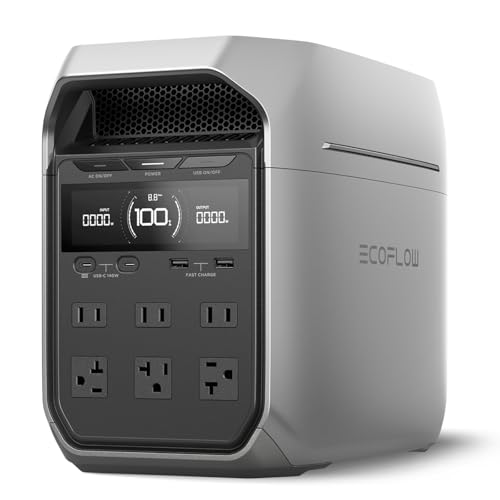
$719 at Amazon, September 16, 20261,024 Wh (870 usable)1,800 W continuous3,600 W peak28 lb
The EcoFlow DELTA 3 Plus is here for scale, and it makes the case for spending more: it takes the most solar of the three by a wide margin, it is the only one that accepts an add-on battery, its five-year warranty is documented on the maker's own page, and it has a verified listing at $719. It is also the heaviest and the dearest, and its continuous output falls between the other two. Buy it if the plan involves panels or a second battery rather than riding out one working day.
Against the worst case it is 1,930 Wh short: about 1.9 hours of full sun at its 1,000 W solar input, or roughly 10 hours from one 200 W panel, and real panels deliver less than their rating.
The listing we verified as the bare unit; the price is on Amazon.
A refrigerator for an 8-hour working-day outage:
- Energyonly in the best case
- Running loadyes, even in the worst case
- Starting surgeyes, even in the worst case
Living with it
Its rated handover when the grid drops is the quickest of the three on paper, and a bench test measured it quicker still. Pass-through engages by itself, and an app setting makes the unit run appliances from its own battery instead of passing grid power along. A wall refill is fast, though the same bench test found it pulls appreciably more out of the socket than the battery ends up holding, which matters if the refill comes off a generator. The AC sockets time out when idle rather than at a low-wattage threshold, and the timeout can be set to never, which is what a fridge needs.
Heat and fan noise are the recurring complaint, and the place where the marketing parts company with the measurements. EcoFlow publishes one quiet figure with no load or distance attached to it, while a bench test found the noise floor climbing well past it at higher output; more than one reviewer heard the fan clearly under load and found the case warm on light duty. One owner in EcoFlow's official group reported the battery draining unusually fast with the AC inverter left on, and no idle draw for this model appears in anything we could verify.
- Switchover when the grid drops
- 10 ms rated; bench-tested at just over 8 mscdn11.bigcommerce.com
- Pass-through charging
- Yes, automatic Bypass Mode; app can disable grid pass-throughcdn11.bigcommerce.com
- Wall recharge
- 0-100% in about 56 minutes at 1500W AC inputus.ecoflow.com
- Noise
- About 30 dB claimed; bench test found under 40 dB above 1200Wus.ecoflow.com
- Charges between
- 0°C to 45°C (32°F to 113°F)cdn11.bigcommerce.com
- Low-load shutoff
- AC outlets auto-shutoff after idle; adjustable, can disablecdn11.bigcommerce.com
- Expansion
- Yes, via XT150 port; expandable up to 5 kWh totalcdn11.bigcommerce.com
- Warranty
- 5-year warrantyus.ecoflow.com
What owners report, from public threads and long-term reviews; not our own testing.
- Several reviewers found fan noise stays near the claimed 30 dB under light loads but climbs to about 40 dB above 1200W, with thermal management flagged as a recurring weak point.storagereview.com
- A buyer in EcoFlow's own owner Facebook group reported the battery drained unusually fast whenever the AC inverter was left switched on.facebook.com
- One reviewer's older vehicle could not deliver the full rated 800W car-charging input, so 12V recharge fell short of the advertised roughly 1.3-hour full-charge time.tech.yahoo.com
- A bench test clocked the UPS transfer time at just over 8 ms, beating the 10 ms spec, though the same reviewer said the unit ran warmer than expected even during light use.storagereview.com
What independent testers measured
We do not test units ourselves. These are figures published by testers who did, with the maker’s claim beside them where the tester gave it.
- Rated 8.5/10 and called the sweet spot between capacity and expandability in EcoFlow's DELTA 3 lineup, but the review itself is spec-based rather than lab-tested. Backup Power Hub
- In its DELTA 3 vs DELTA 3 Plus comparison, recommends the Plus specifically for buyers who value the doubled solar input and broader battery/USB-C support over the base DELTA 3. Backup Power Hub
What you give up
The money and the weight. It is the dearest of the three for the same clears-the-best-case-only verdict and the heaviest to carry, and if panels and a second battery are not part of the plan, the extra input and the expansion port buy nothing. It also gives up continuous output to the Anker SOLIX C1000 Gen 2 for the privilege.
Figures from us.ecoflow.com, captured August 12, 2026; recall screen: no published recall names this exact model (screened 2026-08-12) (how we screen, CPSC).
Buying it right
A search for any of these models returns bundles, sibling models and, often, the same unit under two listings at different prices. We link only a listing whose own title states the bare unit and its exact battery and output; the box should say the same. Check the seller is the maker or Amazon itself, and that the model number on the label matches the one on this page.
Jackery Explorer 1000 v2
- The listing we verified: “Jackery Explorer 1000 v2 Portable Power Station,1070Wh,1500W”, $559 when checked. Title states 1070Wh and 1500W, matching our record exactly.
- “Jackery Explorer 1000 v2 and Extension Cable,1070Wh,1500W AC”, $499: a bundle, not the bare unit; the extra hardware is in the price.
- “Jackery Explorer 1000 v2 Portable Power Station,1070Wh,1500W (Dune White)”, $589: the same unit under a second listing at $589; we link the cheaper verified one.
Anker SOLIX C1000 Gen 2
- “Anker SOLIX C1000 Gen 2 Portable Power Station with 200W Solar Panel”, $740: a bundle, not the bare unit; the extra hardware is in the price.
- “Anker SOLIX C2000 Gen 2 Portable Power Station, 2,048Wh, 2,400W, Camping”, $900: a different model that a search for this one returns.
- “Anker SOLIX C1000 Gen 2 Portable Power Station, 2-Pack”, $1,100: Listing title does not state a capacity, so base-unit identity cannot be confirmed..
EcoFlow DELTA 3 Plus
- The listing we verified: “EF ECOFLOW Portable Power Station DELTA 3 Plus 1024Wh, 1800W, LFP Battery”, $719 when checked. Title states 1024Wh and 1800W, matching our record exactly.
- “EF ECOFLOW Delta 3 Portable Power Station, 1024Wh 1800W”, $629: a different model that a search for this one returns.
- “EF ECOFLOW Solar Generator DELTA 3 Plus with 400W Solar Panel, 1024Wh 1800W”, $1,459: a bundle, not the bare unit; the extra hardware is in the price.
What this page can’t promise
This page cannot tell you which end of the fridge range your own kitchen sits on, and that is the question deciding whether either box is enough. It cannot promise the worst case either: neither covers it, and the answer to that is a recharge, panels or a bigger battery.
It cannot give you a price for the Anker SOLIX C1000 Gen 2 either, because no bare-unit listing passed our check. Nothing here was tested by us. The spec figures are the makers' own, what reviewers and owners found is labelled as theirs, and where Jackery's marketing and its own spec table disagree, we say so rather than quote the better number.
Questions people ask
Is the C1000 Gen 2 louder than the Jackery?
On the makers' own badges, no: both quote a very low fan figure. The measurements are another matter. One reviewer measured the Anker far above its badge at a metre during fast charging and another found it much quieter at moderate load; on the Jackery, one tester measured it clearly audible once output climbed toward its rating while another called it fairly quiet next to rivals. Both are quiet idling and neither is when working hard.
Which one charges faster?
The Anker SOLIX C1000 Gen 2, on the claims and on the measurements. Anker advertises a full charge from empty in under an hour with its fast mode enabled, and an independent test came in a little longer while holding a high input almost to the end. Jackery's own pages give three different times for the same job, and two testers measured two different results, the quicker of them only with emergency charging switched on by hand.
Is the C1000 Gen 2 the same as the C1000 I looked at before?
No. They share most of a name and are different units: the Gen 2 differs in output, and it drops the expansion port and the built-in light the first-generation C1000 has in exchange for a smaller, lighter case. The older one is in the table on this page for scale only. If you are shopping from listing titles, match the model exactly, because the bundles and multi-packs make it easy to get wrong.
Why is there no price for the Anker SOLIX C1000 Gen 2?
Because no listing for the bare unit passed our check. What came up was the Gen 2 packed with a solar panel, packed with an alternator charger, sold as a two-pack with no capacity in the title, and a larger model with a similar name. Rather than quote a bundle price as though it were the box on its own, the page leaves it blank; check the title against the capacity and the output before you buy.
Will either one get my fridge through the whole outage?
In the easy case, an efficient fridge in a cool kitchen with the door mostly shut, yes: both clear 160 watt-hours comfortably. In the hard case, an old fridge in a warm kitchen opened all day, neither does, and both land on clears the best case only. Of the 58 stations checked against this plan, 8 cover the hard end, and neither of these two is among them.
Other plans we sized
- Home backupThe best portable power stations for home backup
A fridge, the internet, a few lamps and everyone's phones through a day without the grid, indoors, with no engine to run. Sized on the harder end of every range.
- Camping and road tripsThe best portable power stations for camping
Two nights of phones, a laptop and a few lights is a small job with a wide range, and the range is what catches people out. All three picks cover the easy end of it on one charge; the hard end takes a panel at the site or a full charge before you leave.
- CPAPPortable power for a CPAP machine: one night, and three
A CPAP is a small, steady load, so this comes down to battery size and one switch: the heated humidifier. Covering a single night is settled; covering three, or running the heat, takes a bigger box.
- Portable generatorsThe best portable generators for home backup
Three generators judged on the one number that decides the job: the watts on tap for the second a fridge and a chest freezer both restart at once. Not battery capacity, and not the running total.
- ComparedWhich EcoFlow DELTA 3? The whole family, judged against one plan
Every EcoFlow DELTA 3 variant on one table with the maker's own figures, the gaps marked, and all of them run against the same refrigerator plan.
- ComparedThe one-kilowatt-hour class: Jackery 1000 v2, Anker C1000, EcoFlow DELTA 3
The most-searched 1 kWh power stations on one table, run against the same fridge plan, with expansion, solar input and warranty from the makers.
- RefrigeratorHow much battery it takes to run a refrigerator, and which power station does it
A fridge is the appliance everyone wants kept running, and the one whose appetite varies most from house to house. Size it on the harder end of that range and the choice of station mostly makes itself.
- Sump pumpThe best portable power stations for a sump pump
A sump pump is a motor that starts hard and then runs in bursts: the starting surge decides which station can start it at all, and the weather decides how much energy it drinks. Sized on the harder end of every range.
- FurnaceThe best portable power stations for a gas furnace
A gas furnace burns its own fuel and asks the grid only for the blower and the control board, which is the good news. The bad news is that both are wired into the house, so the battery is half the job and an electrician is the other half.
- Well pumpThe best backup power for a well pump
A well pump is the hardest start in an ordinary house, and it is wired in at 240 volts rather than plugged into anything. That is why this plan usually lands on a generator, and why every figure here is sized on the harder end of its range.
- ComparedEcoFlow DELTA 3 vs DELTA 2: what changed, and which one to buy
EcoFlow's DELTA 2 and DELTA 3, plus the DELTA 3 Plus and Classic, on one table from the makers' own figures and judged against one fridge plan.
- ComparedJackery Explorer 1000 v2 vs 1000 Plus: the expandable one or the cheaper one
Jackery's Explorer 1000 v2 and 1000 Plus on one table from the maker's own figures, judged against one fridge plan, with the 2000 v2 for scale.
- Camping with a fridgeThe best portable power stations for camping with a fridge
Put a compressor fridge in the back of the car and it becomes most of the battery: it is the one thing in your kit that keeps drawing while you sleep. We size this page from the hard end of every range.
- GuidePower station or generator: which do you actually need?
This is the decision that comes before choosing a product, and it is the expensive one to get wrong in either direction. A battery bought for a well pump is wasted money; a standby generator bought to keep a router alive is a great deal more of it.
- GuideHow to connect a power station to your house
These four methods differ less in how much power they move than in what they can reach: a cord reaches a plug, transfer equipment reaches a circuit. The fifth thing people try, a cord into a wall socket, can kill the line worker restoring your power.
- GuideSolar panels for a power station: how many, and how long
Panels are where the optimism creeps into a backup plan. The arithmetic is simple enough to do on the back of an envelope, and the answer it gives you is the best case, not the likely one.
- GuideExpansion batteries: what an extra battery for a power station actually does
An extra battery for a power station is the cheapest-sounding fix for the wrong problem about half the time. It buys hours, it does not buy watts, and the pack you buy has to be the exact one your station was built for.
Jackery Explorer 1000 v2Our pick
Check price at Amazon