EcoFlow DELTA 3 vs DELTA 2: what changed, and which one to buy
The same battery, a generation apart: the EcoFlow DELTA 2 (EFD330) and the EcoFlow DELTA 3 hold identical capacity behind different inverters, inputs and expansion ports. This page is about what EcoFlow changed, and whether the older box is still the one to buy.
Buy the EcoFlow DELTA 3: it is the current generation, it carries a verified listing, and in the listings we checked it is the cheaper of the two at $629 against the EcoFlow DELTA 2 (EFD330)'s $699. The older box is still worth having if a real discount turns up, because the battery inside is the same one and reviewers say base wall-charging speed and output are comparable across the generations. Take the EcoFlow DELTA 3 Plus instead if panels or a second battery are part of the plan, since it is the only one of the three with the wider solar input, a documented expansion path and a warranty term in our record. All three land on the same verdict against this plan, “Clears the best case only”, so none of them carries a hard-working fridge through the window without a refill.
The Amazon links on this page are affiliate links: if you buy through one we may earn a commission, at no extra cost to you. It does not change which units are picked. How that works.
| Model | Usable | Output | Short of worst case | Weight | Price | |
|---|---|---|---|---|---|---|
| Our pick | EcoFlow DELTA 3 | 870 Wh | 1,800 W | 1,930 Wh | 28 lb | on Amazon |
| The previous generation | EcoFlow DELTA 2 (EFD330) | 870 Wh | 1,800 W | 1,930 Wh | 26 lb | on Amazon |
| The one with more inputs | EcoFlow DELTA 3 Plus | 870 Wh | 1,800 W | 1,930 Wh | 28 lb | on Amazon |
Who this is for
You are looking at two boxes that hold the same battery and wondering whether the newer badge is worth paying for, or whether last generation's discount is the smarter move. The plan on this page is deliberately narrow: a refrigerator for an 8-hour working-day outage, one fridge running by itself, nothing else on the circuit. If that is your question, read on.
Leave if you need a unit that carries a hard-working fridge through the whole window without a refill, because not one of these three does that; our home-backup page lists every unit we track that clears the worst case, across brands. Leave too if you are really weighing the DELTA 3 Plus against the Classic, the Ultra or the Max rather than against the DELTA 2, because that comparison has its own page.
Side by side, from the makers’ own documents
“Not captured” means the maker’s page we captured does not state it: a gap in our record, not a zero, and never filled from a sibling model. “No verified listing” means no Amazon listing for the bare unit passed our identity check yet.
| Model | Battery | Continuous output | Peak output | Weight | Solar input | Expandable | Warranty | Chemistry | Verified listing |
|---|---|---|---|---|---|---|---|---|---|
| EcoFlow DELTA 3 | 1,024 Wh | 1,800 W | 3,600 W | 28 lb / 12.5 kg | 500 W | not captured | not captured | LiFePO4 | $629 |
| EcoFlow DELTA 2 (EFD330) | 1,024 Wh | 1,800 W | 2,700 W | 26 lb / 12.0 kg | 500 W | not captured | not captured | LiFePO4 | $699 |
| EcoFlow DELTA 3 Plus | 1,024 Wh | 1,800 W | 3,600 W | 28 lb / 12.5 kg | 1,000 W | documented by the maker (accessory not named on the page we captured) | 5 years | LiFePO4 | $719 |
| EcoFlow DELTA 3 Classic (1024Wh) | 1,024 Wh | 1,800 W | 3,600 W | 27 lb / 12.1 kg | 500 W | not captured | not captured | LiFePO4 | $559 |
Against the same plan
A refrigerator for an 8-hour working-day outage, sized on the harder end of every range.
Start with what did not change. Both generations carry the same nominal battery, the same usable figure and the same continuous output in our record, and they sit within half a kilogram of each other on the scale. The money buys no capacity.
It buys headroom and inputs. The DELTA 3 posts the higher peak, 3,600 watts against the DELTA 2 (EFD330)'s 2,700, and reviewers comparing the two name three gains for the newer box: alternator charging, that surge ceiling and a larger maximum expansion. Treat surge as the soft figure: those same reviewers quote a lower ceiling for the older unit than the peak in our maker-sourced table. On paperwork the DELTA 3 Plus claims the longest cycle life, the DELTA 2's manual a shorter one, and the plain DELTA 3 none at all; a warranty term is on file for the DELTA 2 and the Plus and blank for the DELTA 3.
Against this plan it decides less than the badge suggests. A new fridge in a cool kitchen with the door mostly shut needs 160 watt-hours across the window; an old one in a warm kitchen, opened often, needs 2,800, and the compressor asks 600 to 2,900 watts to start. All three clear the running load and the easy start; only the DELTA 3 and the DELTA 3 Plus clear the hard one, the single place the older inverter's lower peak shows up. None clears the top of the energy range: of the 58 units we track across all brands, 45 cover the efficient end.
| Model | Covers the energy | Carries the running load | Clears the surge | Worst-case shortfall | Verdict |
|---|---|---|---|---|---|
| EcoFlow DELTA 3 | best case only | worst case | worst case | 1,930 Wh | Clears the best case only |
| EcoFlow DELTA 2 (EFD330) | best case only | worst case | best case only | 1,930 Wh | Clears the best case only |
| EcoFlow DELTA 3 Plus | best case only | worst case | worst case | 1,930 Wh | Clears the best case only |
| EcoFlow DELTA 3 Classic (1024Wh) | best case only | worst case | worst case | 1,930 Wh | Clears the best case only |
Where the energy goes, load by load
| Load | Hours | Running watts | Duty cycle | Energy | Share of worst case |
|---|---|---|---|---|---|
| Refrigerator/freezer | 8 | 100–700 | 20–50% | 160–2,800 Wh | 100% |
Energy = running watts × duty cycle × hours, at each end of the range. The right-hand end of every row is what the plan is sized on.
Our pickEcoFlow DELTA 3
The current one
$629 at Amazon, September 16, 20261,024 Wh (870 usable)1,800 W continuous3,600 W peak28 lb
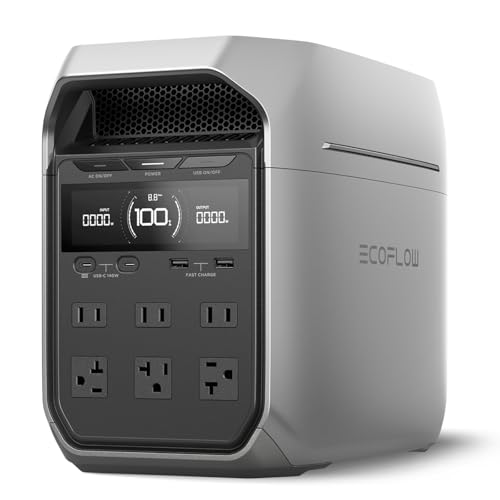
The EcoFlow DELTA 3 is the current generation, it has a verified listing behind it, and in the listings we checked it is the cheaper of the two: the same battery and the same continuous output as the older box, with a higher peak and the newer input ports reviewers say the upgrade is really about. It reads “Clears the best case only” against this plan, exactly as the other two do, so a hard-working fridge still means a recharge or panels. It suits the person who would rather buy the current box than chase a discount on last year's.
Against the worst case it is 1,930 Wh short: about 3.9 hours of full sun at its 500 W solar input, or roughly 10 hours from one 200 W panel, and real panels deliver less than their rating.
The listing we verified as the bare unit; the price is on Amazon.
A refrigerator for an 8-hour working-day outage:
- Energyonly in the best case
- Running loadyes, even in the worst case
- Starting surgeyes, even in the worst case
Living with it
The honest thing first: our ownership record for the plain DELTA 3 is empty. No switchover figure, no charging-temperature range, no idle draw, no cycle life, no warranty term, no wall-charging time. The row carries EcoFlow's headline specs and a verified listing and nothing else, and we will not fill the gaps with the DELTA 3 Plus's figures, which belong to a different box.
What reviewers comparing the generations point to is alternator charging, a higher surge ceiling and a bigger expansion ceiling than the older unit allows: their three reasons to move up. Those same reviewers say base wall-charging speed and output are much alike across the two, which is why several of them still send buyers to the older box when it is cheaper. Solar input is the one input figure we hold for this unit, and it matches the DELTA 2's exactly; no expansion accessory and no wall-charging time is captured for it.
Two cautions do carry over. EcoFlow's product pages load their spec tables with JavaScript, so most of what we hold for this family came out of the manual PDFs instead, and where a marketing page and its manual disagree, as they do on this shelf, we print both rather than the better one. And the shelf is thick with near-identical names: checking this one listing turned up Classic, Plus and Max variants at several different prices. Match the model number on the box, not the badge in the photograph.
What you give up
The record behind it. This is the one box on the page with no ownership intel at all, no long-term tester, no measured noise, no confirmed warranty, while the EcoFlow DELTA 2 (EFD330) beside it has years of reports attached. It does not clear the hard end of this plan either, and if panels or a second battery are anywhere in your future, the EcoFlow DELTA 3 Plus is the one with the documented path.
Figures from us.ecoflow.com, captured August 13, 2026; recall screen: not screened against the recall database yet (how we screen, CPSC).
The previous generationEcoFlow DELTA 2 (EFD330)
The previous generation
$699 at Amazon, September 16, 20261,024 Wh (870 usable)1,800 W continuous2,700 W peak26 lb
The EcoFlow DELTA 2 (EFD330) holds the same battery behind the older inverter and the older inputs, and reviewers comparing the generations keep recommending it to anyone who does not specifically need alternator charging, more surge or more expansion. It now has a verified listing of its own, which is the problem: at $699 against the newer box's $629, the discount an older generation is supposed to come with is not there. It is the pick when a real markdown puts it well under the DELTA 3, and not otherwise.
Against the worst case it is 1,930 Wh short: about 3.9 hours of full sun at its 500 W solar input, or roughly 10 hours from one 200 W panel, and real panels deliver less than their rating.
The listing we verified as the bare unit; the price is on Amazon.
A refrigerator for an 8-hour working-day outage:
- Energyonly in the best case
- Running loadyes, even in the worst case
- Starting surgeonly in the best case
Living with it
Between the wall and the fridge it passes grid power through and picks the load up when the grid drops, a handover of a few hundredths of a second. EcoFlow is blunt about that in writing: not a zero-millisecond UPS, not for servers or data equipment. A fridge does not care. The outlets shut off after an idle stretch, and the unit itself after a longer one; set the timeout to never or a quiet spell will cut the fridge loose.
Charging is where the maker argues with itself: the product page sells a fast partial wall charge, the manual's diagram a longer figure for a full one, measured differently, so we print both rather than the flattering one. It will not charge below freezing or in real heat. The manual claims thousands of cycles before capacity falls below four-fifths, and a tester who lived with one for half a year reported no measurable loss and a case still solid as day one.
Fan noise is the complaint that follows this model, and the testers disagree on how bad it is. One measured it at close range during maximum wall charging, called the tone small and shrill, his biggest annoyance, and found the fans kick in at surprisingly light loads, enough to rule it out beside quiet bedroom medical equipment. The long-term tester's curve is gentler: near-silent at light draw, loud only near the top of the range. That reviewer also had two firmware updates pushed out of the box, and was told a later one would target the fans.
- Switchover when the grid drops
- About 30 ms UPS switchover; not for serverswebsiteoss.ecoflow.com
- Pass-through charging
- Yes, via AC bypass while chargingwebsiteoss.ecoflow.com
- Wall recharge
- 0-80% in about 50 min (full charge in about 1.2 h per manual)ecoflow.com
- Charges between
- 0°C to 45°C (32°F to 113°F)websiteoss.ecoflow.com
- Low-load shutoff
- Shuts off after 2 hours with no load by defaultwebsiteoss.ecoflow.com
- Warranty
- 5-year warrantyecoflow.com
What owners report, from public threads and long-term reviews; not our own testing.
- Fan noise is the most common complaint: one reviewer measured about 57 dBA during max AC charging and found fans trigger even at light loads around 120W.pcworld.com
- A second long-term tester found the fans quieter overall, scaling from near-silent under light loads to 48-55 dB at maximum draw, milder than the max-charging measurement.portablepowerlab.com
- A 6-month long-term tester reported no measurable battery degradation after 150+ charge cycles, saying the unit still felt as solid as day one.portablepowerlab.com
- Compared with the newer DELTA 3, reviewers note this model lacks alternator charging, has a lower 2,200W surge ceiling, and maxes out at 3 kWh with one expansion battery.backuppowerhub.com
What independent testers measured
We do not test units ourselves. These are figures published by testers who did, with the maker’s claim beside them where the tester gave it.
| Measurement | Result | Tester |
|---|---|---|
| Noise under load, measured | 45-50 dB fan noise noticeable under heavy load | Power Station Advisor |
| Wall charge, to 80% | Reached 80% in roughly 48-52 minutes per the tester's own verified benchmarks (maker: EcoFlow's rated spec of 0-80% in 50 minutes) | Power Station Advisor |
| Weight, measured | 27 lb, described by the tester from hands-on handling as substantial but one-hand-carryable (maker: 27 lb manufacturer spec) | Power Station Advisor |
| Also measured | Powered an 18 cu ft refrigerator for 8-10 hours in the tester's own real-world test | Power Station Advisor |
- After 18 months of testing, named a top recommendation and 'Best Overall Portable Power Station' / 'Our Top Pick' in its class. (Best Overall Portable Power Station) Power Station Advisor
- The better choice versus the DELTA 2 Max for individuals or couples who prioritize portability and essential backup without overspending. Power Station Advisor
What you give up
The price, as things stand. Same battery, lower peak, fewer inputs, no alternator charging and a smaller expansion ceiling than the newer box, and in the listings we checked it asks more money. It is also the only one of the three that fails the hard start in our table. Buy it discounted or not at all; the EcoFlow DELTA 3 is sitting beside it for less.
Figures from websiteoss.ecoflow.com, captured September 16, 2026; recall screen: not screened against the recall database yet (how we screen, CPSC).
The one with more inputsEcoFlow DELTA 3 Plus
The one with more inputs
$719 at Amazon, September 16, 20261,024 Wh (870 usable)1,800 W continuous3,600 W peak28 lb
The EcoFlow DELTA 3 Plus is the same battery again behind the inputs the other two lack: roughly twice the solar the DELTA 2 will take, a faster wall charge, an extra-battery port and a maker-documented path to several times the capacity it ships with. It is also the only one of the three with a warranty term in our spec record and the only one screened against the recall database. It suits the person buying the start of a kit rather than a single box, panels now and a second battery later.
Against the worst case it is 1,930 Wh short: about 1.9 hours of full sun at its 1,000 W solar input, or roughly 10 hours from one 200 W panel, and real panels deliver less than their rating.
The listing we verified as the bare unit; the price is on Amazon.
A refrigerator for an 8-hour working-day outage:
- Energyonly in the best case
- Running loadyes, even in the worst case
- Starting surgeyes, even in the worst case
Living with it
It sits between the wall and the fridge the same way, with the quickest handover of the three on paper and a bench test that beat the rating slightly. Bypass engages by itself, and an app setting makes it run appliances off its own battery instead of passing grid power through. It refills faster than the older generation, though that test found it pulls noticeably more from the wall than the battery holds.
The port on the back is what the money is for: it takes EcoFlow's expansion pack and doubles as a DC input for alternator chargers and smart generators, up to a ceiling the maker documents. The AC outlets time out when idle rather than at a low-wattage threshold, and the timeout can be set to never, which is what you want behind a fridge. The app works over Wi-Fi and Bluetooth, and this one also talks to EcoFlow's desktop software.
Heat and fan noise are the recurring complaint, and marketing and measurement part company. The product page gives one quiet decibel figure with no load or distance attached; the bench tester found the fan near it at moderate output and clearly louder past that, and more than one reviewer found the case warm on light duty. One reviewer's older car could not feed the DC input at its rated wattage, so the advertised car-charge time fell short. A buyer in EcoFlow's owner group reported the battery draining fast with the inverter left on; no idle-draw figure is confirmed here, and we will not borrow a sibling's.
- Switchover when the grid drops
- 10 ms rated; bench-tested at just over 8 mscdn11.bigcommerce.com
- Pass-through charging
- Yes, automatic Bypass Mode; app can disable grid pass-throughcdn11.bigcommerce.com
- Wall recharge
- 0-100% in about 56 minutes at 1500W AC inputus.ecoflow.com
- Noise
- About 30 dB claimed; bench test found under 40 dB above 1200Wus.ecoflow.com
- Charges between
- 0°C to 45°C (32°F to 113°F)cdn11.bigcommerce.com
- Low-load shutoff
- AC outlets auto-shutoff after idle; adjustable, can disablecdn11.bigcommerce.com
- Expansion
- Yes, via XT150 port; expandable up to 5 kWh totalcdn11.bigcommerce.com
- Warranty
- 5-year warrantyus.ecoflow.com
What owners report, from public threads and long-term reviews; not our own testing.
- Several reviewers found fan noise stays near the claimed 30 dB under light loads but climbs to about 40 dB above 1200W, with thermal management flagged as a recurring weak point.storagereview.com
- A buyer in EcoFlow's own owner Facebook group reported the battery drained unusually fast whenever the AC inverter was left switched on.facebook.com
- One reviewer's older vehicle could not deliver the full rated 800W car-charging input, so 12V recharge fell short of the advertised roughly 1.3-hour full-charge time.tech.yahoo.com
- A bench test clocked the UPS transfer time at just over 8 ms, beating the 10 ms spec, though the same reviewer said the unit ran warmer than expected even during light use.storagereview.com
What independent testers measured
We do not test units ourselves. These are figures published by testers who did, with the maker’s claim beside them where the tester gave it.
- Rated 8.5/10 and called the sweet spot between capacity and expandability in EcoFlow's DELTA 3 lineup, but the review itself is spec-based rather than lab-tested. Backup Power Hub
- In its DELTA 3 vs DELTA 3 Plus comparison, recommends the Plus specifically for buyers who value the doubled solar input and broader battery/USB-C support over the base DELTA 3. Backup Power Hub
What you give up
The price and the overlap. It is the dearest of the three and covers exactly the same fridge case as the other two, so unless panels or a second battery are genuinely in the plan, the EcoFlow DELTA 3 gives you the same battery, the same output and the same peak for less. The extra inputs are headroom you may never use.
Figures from us.ecoflow.com, captured August 12, 2026; recall screen: no published recall names this exact model (screened 2026-08-12) (how we screen, CPSC).
Buying it right
A search for any of these models returns bundles, sibling models and, often, the same unit under two listings at different prices. We link only a listing whose own title states the bare unit and its exact battery and output; the box should say the same. Check the seller is the maker or Amazon itself, and that the model number on the label matches the one on this page.
EcoFlow DELTA 3
- The listing we verified: “EF ECOFLOW Delta 3 Portable Power Station, 1024Wh 1800W”, $629 when checked. Title states 1024Wh and 1800W, matching our record exactly.
- “EF ECOFLOW Portable Power Station Delta 3 Classic, 1024Wh 1800W AC”, $559: the same unit under a second listing at $559; we link the cheaper verified one.
- “EF ECOFLOW Portable Power Station Delta 3 Classic with Solar Charge Cable”, $499: a bundle, not the bare unit; the extra hardware is in the price.
- “EF ECOFLOW Portable Power Station DELTA 3 Plus 1024Wh, 1800W, LFP Battery”, $719: Listing is the 'DELTA 3 Plus' variant, which is a different product from the 'DELTA 3' in our record..
- “EF ECOFLOW DELTA 3 Max Portable Power Station, 2048Wh LFP Battery, 2400W”, $1,199: Listing is the 'DELTA 3 Max' variant, which is a different product from the 'DELTA 3' in our record..
EcoFlow DELTA 2 (EFD330)
- The listing we verified: “EF ECOFLOW Portable Power Station Delta 2, 1024Wh, 1800W, LiFePO4 Battery”, $699 when checked. Title states 1024Wh and 1800W, matching our record exactly.
- “EF ECOFLOW Portable Power Station DELTA 2 Max 2048Wh, 2400W LiFePO4 Battery”, $1,049: Listing is the 'DELTA 2 Max' variant, which is a different product from the 'DELTA 2' in our record..
- “EF ECOFLOW Solar Generator Delta 2 with 220W Solar Panel, 1024Wh 1800W”, $1,136: a bundle, not the bare unit; the extra hardware is in the price.
- “EF ECOFLOW Portable Power Station Delta 3 Classic, 1024Wh 1800W AC”, $559: a different model that a search for this one returns.
EcoFlow DELTA 3 Plus
- The listing we verified: “EF ECOFLOW Portable Power Station DELTA 3 Plus 1024Wh, 1800W, LFP Battery”, $719 when checked. Title states 1024Wh and 1800W, matching our record exactly.
- “EF ECOFLOW Delta 3 Portable Power Station, 1024Wh 1800W”, $629: a different model that a search for this one returns.
- “EF ECOFLOW Solar Generator DELTA 3 Plus with 400W Solar Panel, 1024Wh 1800W”, $1,459: a bundle, not the bare unit; the extra hardware is in the price.
What this page can’t promise
This page cannot tell you which end of that range your own fridge sits on, and that is the question deciding whether any of these is enough. Nor can it say what the plain DELTA 3 is like to live with: our ownership record for it is empty, and every owner report here belongs to the DELTA 2 or the Plus.
Nothing here was tested by us. The spec figures are EcoFlow's own; what owners and reviewers found is labelled as theirs, and where they disagree, as on fan noise, we say so rather than pick a side. Neither generation is screened against the recall database yet.
Questions people ask
What actually changed between the EcoFlow DELTA 2 and the DELTA 3?
The battery did not. Both hold the same nominal and usable capacity and the same continuous output, and they weigh within a little of each other. What changed is the inverter's peak, the input side and the expansion ceiling. Reviewers who have used both point to alternator charging, more surge headroom and a bigger expansion ceiling as the gains, while rating the two alike for wall-charging speed and output. The table above gives each figure from the makers' own documents.
Is the DELTA 2 still worth buying?
Only at a real discount. It covers this plan's best case exactly as the newer box does, and an owner who ran one for months reported no measurable capacity loss, so there is nothing wrong with the hardware. But it now carries a verified listing of its own at $699, above the EcoFlow DELTA 3's $629; it fails the hard start in our table where the newer one passes; and it gives up alternator charging and expansion room. Cheaper, yes. Otherwise, no.
Why is the older DELTA 2 listed for more than the DELTA 3?
We do not know, and we will not guess at it. Both prices above come from listings whose titles we matched against our specification record, and that is the ordering on the day the page was built. Older generations often sit at odd prices while stock runs down and the new model is promoted. Check both before you buy, and if the older one is still the dearer, the decision makes itself.
Can I use my DELTA 2 accessories, like the extra battery, with the DELTA 3?
Not captured. Our record documents no expansion accessory for either the DELTA 2 or the plain DELTA 3; reviewers cite a smaller expansion ceiling for the older generation, but nothing we hold says which pack fits which box, or whether one carries across a generation. The EcoFlow DELTA 3 Plus is the only one of the three with an extra-battery port named in our data. Ask EcoFlow before buying a pack on that assumption.
Is the fan loud enough to be a problem in a bedroom?
Depends on the box and the load. On the EcoFlow DELTA 2 (EFD330) the testers disagree: one found it shrill and unpleasant at full wall charging and heard the fans start at light discharge loads, while a long-term tester called it near-silent at everyday draw. The EcoFlow DELTA 3 Plus measures quiet under moderate output and clearly louder above that. None of them is silent while charging hard, so fill it before bedtime rather than beside the bed. EcoFlow has said a firmware update targets the DELTA 2's fans.
Other plans we sized
- Home backupThe best portable power stations for home backup
A fridge, the internet, a few lamps and everyone's phones through a day without the grid, indoors, with no engine to run. Sized on the harder end of every range.
- Camping and road tripsThe best portable power stations for camping
Two nights of phones, a laptop and a few lights is a small job with a wide range, and the range is what catches people out. All three picks cover the easy end of it on one charge; the hard end takes a panel at the site or a full charge before you leave.
- CPAPPortable power for a CPAP machine: one night, and three
A CPAP is a small, steady load, so this comes down to battery size and one switch: the heated humidifier. Covering a single night is settled; covering three, or running the heat, takes a bigger box.
- Portable generatorsThe best portable generators for home backup
Three generators judged on the one number that decides the job: the watts on tap for the second a fridge and a chest freezer both restart at once. Not battery capacity, and not the running total.
- ComparedWhich EcoFlow DELTA 3? The whole family, judged against one plan
Every EcoFlow DELTA 3 variant on one table with the maker's own figures, the gaps marked, and all of them run against the same refrigerator plan.
- ComparedThe one-kilowatt-hour class: Jackery 1000 v2, Anker C1000, EcoFlow DELTA 3
The most-searched 1 kWh power stations on one table, run against the same fridge plan, with expansion, solar input and warranty from the makers.
- RefrigeratorHow much battery it takes to run a refrigerator, and which power station does it
A fridge is the appliance everyone wants kept running, and the one whose appetite varies most from house to house. Size it on the harder end of that range and the choice of station mostly makes itself.
- Sump pumpThe best portable power stations for a sump pump
A sump pump is a motor that starts hard and then runs in bursts: the starting surge decides which station can start it at all, and the weather decides how much energy it drinks. Sized on the harder end of every range.
- FurnaceThe best portable power stations for a gas furnace
A gas furnace burns its own fuel and asks the grid only for the blower and the control board, which is the good news. The bad news is that both are wired into the house, so the battery is half the job and an electrician is the other half.
- Well pumpThe best backup power for a well pump
A well pump is the hardest start in an ordinary house, and it is wired in at 240 volts rather than plugged into anything. That is why this plan usually lands on a generator, and why every figure here is sized on the harder end of its range.
- ComparedJackery Explorer 1000 v2 vs Anker SOLIX C1000 Gen 2
The two 1 kWh units people compare most, from the makers' own figures, judged against one fridge plan, with the older C1000 and the DELTA 3 Plus for scale.
- Camping with a fridgeThe best portable power stations for camping with a fridge
Put a compressor fridge in the back of the car and it becomes most of the battery: it is the one thing in your kit that keeps drawing while you sleep. We size this page from the hard end of every range.
- GuidePower station or generator: which do you actually need?
This is the decision that comes before choosing a product, and it is the expensive one to get wrong in either direction. A battery bought for a well pump is wasted money; a standby generator bought to keep a router alive is a great deal more of it.
- GuideHow to connect a power station to your house
These four methods differ less in how much power they move than in what they can reach: a cord reaches a plug, transfer equipment reaches a circuit. The fifth thing people try, a cord into a wall socket, can kill the line worker restoring your power.
- GuideSolar panels for a power station: how many, and how long
Panels are where the optimism creeps into a backup plan. The arithmetic is simple enough to do on the back of an envelope, and the answer it gives you is the best case, not the likely one.
- GuideExpansion batteries: what an extra battery for a power station actually does
An extra battery for a power station is the cheapest-sounding fix for the wrong problem about half the time. It buys hours, it does not buy watts, and the pack you buy has to be the exact one your station was built for.
EcoFlow DELTA 3Our pick
Check price at Amazon