EcoFlow DELTA 3 Plus
On one charge the EcoFlow DELTA 3 Plus runs a typical refrigerator about 9 hours, and runs an older furnace blower about 4.5 hours.
Buy it if you want up to 1,000 W of solar input, or an extra battery later (up to 5 kWh in all).
Skip it if you only need power at home in an outage. The EcoFlow DELTA 3 Classic has the same 1,024 Wh battery and 1,800 W output, so it runs a fridge just as long. What to buy instead.
Price: $719 on Amazon (checked November 1, 2026).
1,024 Wh battery (847 usable)1,800 W output3,600 W peak
$849 per usable kWh at Amazon prices checked November 1, 2026 ($719 for 847 usable Wh). How we work it out
Price checked November 1, 2026; Amazon shows today’s price. This is the listing for this model on its own, not a bundle.

Planning figures: a typical refrigerator averages about 83 W; an older furnace blower averages about 182 W. Yours may use less or more; the range is in the table below. How long other power stations run a refrigerator. A furnace blower is wired in: it needs an inlet or transfer switch fitted by an electrician.
- Wall recharge
- up to 1,500 W from the wall; 0-100% in about 56 minutes at 1500W AC input
- Extra batteries
- Yes, via XT150 port; expandable up to 5 kWh total
- Recalls
- no CPSC recall names this exact model (screened 2026-10-09)
Check you have the right model. Not the same as: EcoFlow DELTA Pro 3 (a similar name, a different model: 4,096 Wh, 4,000 W); EcoFlow DELTA 3 Classic (1024Wh) (the same battery and output); EcoFlow DELTA 3 (a similar name with the same battery and output); EcoFlow RIVER 3 Plus (a similar name, a different model: 286 Wh, 600 W); EcoFlow DELTA 2 (EFD330) (the same battery and output). Read the model name on the unit’s label, not the box or the listing.
What independent tests measured
- Usable energy: about 888 Wh (839–990) across 14 tests at 200 W or more, by labs, reviewers and owners, including Everyday Solar (YouTube), Gear & Gadget Reviews (YouTube), City Prepping (YouTube), YouTube tester, Reddit owner (r/Ecoflow_community).
- Power it uses just to stay on: about 17 (14.9–20) W with the AC outlets on and nothing plugged in (Gear & Gadget Reviews (YouTube), Reddit owner (r/Ecoflow_community)). Current firmware. Launch firmware measured about 26 to 41 W.
- On the 12 V port: about 5 W of standby, with no inverter loss.
- What we use: 847 Wh usable at a typical 300 W load; every hours figure on this page counts the idle draw. The one rule we use.
How long will the EcoFlow DELTA 3 Plus run a fridge, CPAP, sump pump or furnace?
| Appliance | Average draw | On one charge | Starts it? |
|---|---|---|---|
| Fridge, new and efficient (ENERGY STAR) | 54 W | about 13 h | starts it |
| Fridge, typical | 83 W | about 9 h | starts it |
| Fridge, old or large | 130 W | about 6.1 h | starts it |
| CPAP, heated humidifier on | 55 W | about 1.5 nights (13 h) | starts it |
| CPAP, humidifier off, from the 12 V car socket | 11.2 W | about 7.6 nights | starts it |
| Sump pump | 136 W | about 5.9 h (1.6–18 h) | may not start a hard-starting one |
| Gas furnace blower, older single-speed | 182 W | about 4.5 h (1–6.6 h) | starts it |
| Gas furnace blower, variable-speed | 132 W | about 6 h | runs it |
| Well pump (240 V) | 65 W | — | needs 240 V |
One appliance at a time, from the 1,024 Wh battery, counting the power it uses just to stay on (847 Wh usable at a 300 W load). Fridge figures come from ENERGY STAR’s list of certified models, plus a 20 W allowance for the power station’s own draw and doors opening. CPAP with the humidifier on is the middle of the 30–100 W a CPAP with a heated humidifier draws; humidifier off is ResMed’s own 12 V figure for an AirSense 10 on ResMed’s DC cord. A night is 8 hours. Pumps and blowers switch on and off, so their average draw is far below their running watts; the hours are hours of outage, and the range runs from one that runs often to one that rarely does. A furnace blower is wired in: it needs an inlet or transfer switch fitted by an electrician. It has no 240 V output, so it cannot run a 240 V well pump (needs 240 V); a 120 V well pump is a different case, so check the pump’s label.
Every appliance we track
The same numbers as a table
| Appliance | Typical average draw | Hours on one charge |
|---|---|---|
| Fridge | 83 W | about 9 h |
| Furnace blower, older single-speed | 182 W | about 4.5 h |
| Furnace blower, variable-speed | 132 W | about 6 h |
| CPAP | 55 W | about 13 h |
| Sump pump | 136 W | about 5.9 h (may not start a hard-starting one) |
| Wi-Fi router and modem | 24 W | about 22 h |
| Laptop | 52 W | about 13 h |
Who should skip the EcoFlow DELTA 3 Plus, and what to buy instead
- You want the same battery and output for home backup: EcoFlow DELTA 3 Classic (1024Wh). 1,024 Wh, 1,800 W output, 120 V only, 26.7 lb; runs a typical fridge about 9.5 hours. $499 at Amazon
- You want the same battery and an extra battery port: EcoFlow DELTA 3. 1,024 Wh, 1,800 W output, 120 V only, 27.6 lb; runs a typical fridge about 9.5 hours. $599 at Amazon
- You want twice the battery: EcoFlow DELTA 2 Max. 2,048 Wh, 2,400 W output, 120 V only, 50.7 lb; runs a typical fridge about 18 hours. $1,049 at Amazon
Prices checked November 1, 2026.


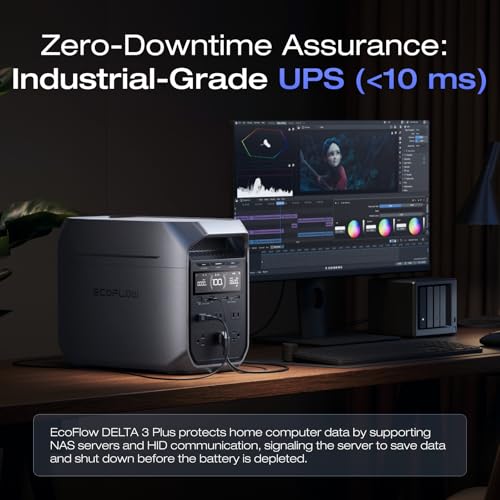
Photos from the listing for this model on its own.
The range behind that
This is a 1,024Wh battery with 1,800W of output, which means it gives back about 847 watt-hours at a typical household load (from independent tests) and can run anything drawing up to 1,800 watts at once.
It runs indoors and makes no fumes. Of the 16 household loads we track, it can run 12 for at least part of a day.
These figures come from a non-US page
The source we captured for this model is a regional page, not the US one. The same product name can carry a different voltage and different outlets between regions, so treat these numbers as needing US confirmation.
https://manuals.ecoflow.com/eu/product/delta-3-plus?lang=en_US3%2F51
Figures from the maker’s own pages and manual, with a link beside each one.
Judged in: Which EcoFlow power station should you buy? (every EcoFlow model compared); Which EcoFlow DELTA 3? The whole family, judged against one plan; EcoFlow DELTA 3 vs DELTA 3 Plus: which one to buy.
What it can run
| Load | Running / starting | Starts it? | Typical | Range |
|---|---|---|---|---|
| Wi-Fi router and modem | 15–40 W | starts it | about 22h | 16–29h |
| Phone charging and small USB devices | 10–40 W | starts it | about 39h | 22–50h |
| A few LED lights | 15–80 W | starts it | about 29h | 12–46h |
| Laptop and monitor | 45–150 W | starts it | about 13h | 5.4–26h |
| CPAP | 30–100 W | starts it | about 13h | 7.7–19h |
| Chest freezer | 80–500 W
starts at up to 2,200 W |
starts it | about 13h | 3.7–32h |
| Sump pump | 700–1,500 W
starts at up to 4,500 W |
may not start a hard-starting one | about 5.9h | 1.6–18h |
| Microwave | 800–1,800 W | starts it | about 29 minutes of running time | short bursts |
| Coffee maker | 700–1,500 W | starts it | about 35 minutes of running time | short bursts |
| Television | 40–250 W | starts it | about 13h | 3.4–32h |
| Garage door opener | 300–800 W
starts at up to 1,800 W |
starts it | about 66 minutes of running time | short bursts |
| 12 V compressor fridge (camping) | 25–110 W
starts at up to 320 W |
starts it | about 26h | 13–41h |
Hours of use on one charge. Typical is the middle of our range for that appliance; the range runs from a hard-working unit to an efficient one. Short-burst loads (microwave, coffee maker, garage door) show running time at full power instead. “Starts it” means the peak output covers even a hard-starting one.
What a kilowatt-hour costs
| What | Amazon price | Usable energy | Per usable kWh |
|---|---|---|---|
| The station | $719 | 847 Wh | $849 |
Per usable kWh = Amazon price divided by usable energy: what the unit gives back at a typical 300 W household load, counting the power it uses just to stay on. The same rule runs everywhere on this site (how). Station price checked November 1, 2026; we show prices only on the day they were checked and keep no price history. Extra battery: EcoFlow lists several extra batteries that fit (DELTA 3, DELTA 2, DELTA 2 Max, DELTA Pro 3 packs), so there is no one pack to price.
Specifications
- Battery
- 1,024 Wh (about 847 Wh usable, from tests)
- Continuous output
- 1,800 W
- Peak output
- 3,600 W
- Output voltage
- 120 V
- Wall recharge
- up to 1,500 W from the wall; 0-100% in about 56 minutes at 1500W AC input source
- Solar input
- up to 1,000 W (XT60)
500W maximum per port; total 1000W. source - Extra batteries
- Yes, via XT150 port; expandable up to 5 kWh total source
- Warranty
- 5 years source
- Weight
- 27.6 lb (12.5 kg) source
Maker page: EcoFlow product page, read 2026-08-12
Manual: EcoFlow manual
Living with it
What the maker’s own pages and manual say about owning this unit, and what owners report in public. Each line links to where it was read. Nothing here is our own test.
- Switchover when the grid drops
- 10 ms rated (maker/manual); independently bench-tested at just over 8 ms by StorageReview, meeting speccdn11.bigcommerce.com
- Pass-through charging
- Supports simultaneous AC recharge + AC discharge ("bypass mode"), engaged automatically; app setting "Disable Grid Bypass" forces the unit's own battery/inverter to supply power instead of passing raw grid power throughcdn11.bigcommerce.com
- Wall recharge
- 0-100% in 56 minutes at 1500W AC input (maker claim); StorageReview's bench test measured ~86.8% charge efficiency (1.18 kWh consumed to fill the 1024Wh battery)us.ecoflow.com
- AC input
- 1500 W max AC input; AC input socket rated 100-120V~15A (50/60Hz) for the US versioncdn11.bigcommerce.com
- USB-C
- 140 W max per USB-C port (2 ports, 280W combined); supports UFCS 36W / PD3.1 / QC3.0cdn11.bigcommerce.com
- Outlets and ports
- 6x AC outlets (120V, pure sine wave, total 1800W/3600W surge); 2x USB-A (36W max/port, 72W total); 2x USB-C (140W max/port, 280W total, UFCS/PD3.1/QC3.0); 1x 12V cigarette-lighter DC port (10A); 2x 12V DC5521 ports (3A each, 126W total for the 12V DC group); 1x Extra Battery port (XT150, DC in/out); 1x Solar/Car (XT60i) charging input; 1x AC charging inputcdn11.bigcommerce.com
- Noise
- ≈30 dB per maker's marketing claim; StorageReview's bench test measured under 30 dB below ~600W load, rising to under 40 dB at ~1200W+ loadsus.ecoflow.com
- Charges between
- 0°C to 45°C (32°F to 113°F)cdn11.bigcommerce.com
- Runs between
- -10°C to 45°C (14°F to 113°F)cdn11.bigcommerce.com
- Cycle life
- 80%+ capacity retained after 4,000 cycles (LiFePO4 cells)cdn11.bigcommerce.com
- Low-load shutoff
- AC output sockets auto-shutoff after an idle timeout (not a fixed low-wattage threshold); the timeout is adjustable in the EcoFlow app and can be set to "never" for continuous loads like a refrigeratorcdn11.bigcommerce.com
- App
- EcoFlow app (iOS/Android, Wi-Fi + Bluetooth control/monitoring/firmware updates); DELTA 3 Plus additionally supports EcoFlow's PC "Power Manager" software (macOS/Windows/Linux) for UPS monitoring/config via wired USB-Ccdn11.bigcommerce.com
- Expansion
- Extra Battery port (XT150) on the rear panel: accepts an EcoFlow Smart Extra Battery for capacity expansion, and also serves as a DC input for EcoFlow alternator chargers/smart generators/microinverters or DC output to power an EcoFlow smart device; maker page states the system is expandable up to 5kWh totalcdn11.bigcommerce.com
- Size
- 8.0 x 15.7 x 11.2 in (W x D x H)cdn11.bigcommerce.com
- Weight
- 27.6 lbcdn11.bigcommerce.com
- Warranty
- 5-year warranty (per maker product page)us.ecoflow.com
What owners report, from public threads and long-term reviews; not our own testing.
- A hands-on reviewer's bench measurements found the fan stayed near the maker's quiet claim (about 30 dB) under roughly 600W of load but climbed to about 40 dB once load reached around 1200W and up, and separately clocked the actual UPS transfer time at just over 8 ms, in line with the 10 ms spec.storagereview.com
- A reviewer testing real-world car charging found their older vehicle could not deliver the full rated 800W to the unit's car-charging input, so their 12V charge fell short of the advertised ~1.3-hour full-charge time; they also noted the unit ran warmer than expected even during light use like laptop charging.tech.yahoo.com
- The same reviewer said the cooling fan was audible even over background noise from a 700W vacuum running nearby, and that after checking other independent write-ups they found fan noise and temperature-control quirks came up as a recurring, not isolated, theme for this model.tech.yahoo.com
- A buyer posting in EcoFlow's own official owner Facebook group reported that their newly purchased DELTA 3 Plus battery drained unusually fast whenever the AC inverter was left switched on.facebook.com
- Fan noise and thermal/temperature management are flagged as a recurring weak point across more than one independent review of this model — the fan becomes clearly audible under moderate-to-heavy loads and the unit can run noticeably warm even during light charging tasks, which one reviewer felt could be a concern for long-term reliability under sustained heavy use.tech.yahoo.com
- Bench testing shows the real-world noise floor rises well above the "30 dB ultra-quiet" marketing figure once output climbs past about 1200W (measured around 40 dB), so the quiet rating mainly holds at lighter loads rather than across the unit's full output range.storagereview.com
What independent testers measured
We do not test units ourselves. These are figures published by testers who did, with the maker’s claim beside them where the tester gave it.
- Rated 8.5/10 and called the sweet spot between capacity and expandability in EcoFlow's DELTA 3 lineup, but the review itself is spec-based rather than lab-tested. Backup Power Hub
- In its DELTA 3 vs DELTA 3 Plus comparison, recommends the Plus specifically for buyers who value the doubled solar input and broader battery/USB-C support over the base DELTA 3. Backup Power Hub
Recall screen
No published recall names this exact model
The single EcoFlow recall (26010) names DELTA Max 2000, model EFD310, a previous-generation product. DELTA 3 Plus is not named.
This check cannot clear your own unit. Most recalls cover only certain serial numbers. Read the model and serial number off the label on the unit itself, then check the maker's recall page before you use it, sell it, or buy it.
How we know the screen was not simply blind
Finding nothing only means something if the search could have found something. So we searched the same records for this brand and got 1 recall. That proves the screen can see this brand, so finding nothing for this model is a real result.
[26010 2025-10-09] EcoFlow Technology Recalls Delta Max 2000 Power Stations Due to Risk of Serious Burn Injury and Fire Hazard
Buying the right one
Verified listing — the unit on its own
ASIN B0DCC2BVFW · $719.00 when checked on November 1, 2026 · purchasable
Title states 1024Wh and 1800W, matching the maker's figures exactly. Prices change: Amazon shows today’s price.
Listings we turned down
Searching for this model returns bundles, sibling models and refurbished units alongside the bare product. These are the ones we checked and did not link, with the reason.
| Listing | Price | Why it is not this product |
|---|---|---|
| EF ECOFLOW Delta 3 Portable Power Station, 1024Wh 1800W | LiFePO4 Battery, Full | $599 | Listing is a different model, not this one. |
| EF ECOFLOW Solar Generator DELTA 3 Plus with 220W Bifacial Panel, 1024Wh | LFP(L | $919 | Listing is a bundle (solar panel or kit), not the bare base unit our specifications describe. |
| EF ECOFLOW Portable Power Station DELTA 3 Plus 1024Wh with Extra Battery | Expan | $1,119 | Listing is a bundle (solar panel or kit), not the bare base unit our specifications describe. |
| EF ECOFLOW DELTA 3 Max Portable Power Station, 2048Wh LFP Battery, 2400W | 3400W | $899 | Listing title does not contain the model name 'DELTA 3 Plus'. |
| EF ECOFLOW Delta 3 Ultra 3072Wh Portable Power Station, 3600W AC Output | (Surge | $1,299 | Listing is a different model, not this one. |
Official accessories
These are the maker’s own words. “Sold on the same page” is not the same claim as “works with this model”.
- DELTA 3 Extra Battery
Maker’s wording: named compatible extra battery - DELTA 2 Extra Battery
Maker’s wording: named compatible extra battery - DELTA 2 Max Extra Battery
Maker’s wording: named compatible extra battery - DELTA Pro 3 Extra Battery
Maker’s wording: named compatible extra battery - 160W Portable Solar Panel
Maker’s wording: named solar option - 220W Portable Solar Panel
Maker’s wording: named solar option - 800W Alternator Charger
Maker’s wording: named accessory - Alternator Charger XT150 Output Cable
Maker’s wording: named cable - Smart Generator 3000 (Dual Fuel)
Maker’s wording: named companion generator