Plug-in solar: is it legal where you live, and what does it make?
Plug-in solar is a small solar kit, panels plus a microinverter, that plugs into a regular wall outlet and lowers your power bill. A state law allows it now in 6 states: Colorado, Connecticut, Maine, Maryland, Utah and Vermont. It becomes legal in California, New Hampshire and Virginia on January 1, 2027; New Jersey about March 1, 2027. In every other state there is no plug-in law yet, so your utility’s normal solar rules apply.
A plug-in kit does not keep your lights on in a blackout. It shuts off when the grid goes down, and most of these laws require that. What to buy for outages
Laws are changing fast. This page shows each law as we read it on October 14, 2026. Check your state’s law and your utility before you buy.
- Size limit
- 1,200 W in most states; Colorado allows 1,920 W, and Maine allows 420 W unless an electrician installs it table
- What it makes
- About 794 to 1,434 kWh a year from 800 W of panels, by mount and city how we got this
- Payback
- About 2 to 15 years for an 800 W kit, if your home uses all it makes the method
- In an outage
- Shuts off, unless it has its own battery why
The Amazon links on this page are affiliate links: if you buy through one we may earn a commission, at no extra cost to you. It does not change which units are picked. How that works.
What plug-in solar is
A plug-in kit is one to six solar panels and a small box called a microinverter. The panels hang on a balcony railing or sit on a stand in the yard. The microinverter turns their power into the same 120 V power your outlets use. You plug its cord into an outlet, and your home uses the solar power first. You buy less power from the utility while the sun is up.
It is not a rooftop system, and it is not a power station. A rooftop system is wired into your panel by an electrician. A power station is a big battery you plug things into. A plug-in kit only works while the grid is on.
Where plug-in solar is legal: state by state
These are the 10 states with a signed plug-in solar law, read in the law itself on October 14, 2026. Every one of them lets you skip the utility’s usual approval contract, and none lets the utility charge you a fee for the kit. They differ on size, safety listing, notice and renters.
| State | Status | Size limit | Safety listing | Tell the utility? | Renters and HOAs | The law |
|---|---|---|---|---|---|---|
| Colorado | Allowed now since August 12, 2026 Landlord and HOA protections, and the rule that kits over 391 W sold in Colorado must be UL listed, start January 1, 2027. | 1,920 W, one device per address | Labeled and listed by a nationally recognized testing lab; from Jan 1, 2027, kits over 391 W must be UL listed to be sold | The utility may ask you to tell it the device is there and its size. No approval or fees. | From Jan 1, 2027, landlords and HOAs cannot unreasonably ban one. | HB26-1007 |
| Connecticut | Allowed now since October 1, 2026 | 1,200 W | UL or another nationally recognized testing lab, meeting UL 1741, IEEE 1547 and the National Electrical Code | No notice. The utility cannot require approval, fees or extra equipment. | Not addressed in the plug-in section. | HB 5340 (Public Act 26-127) |
| Maine | Allowed now since July 29, 2026 | 420 W on your own; up to 1,200 W only with a licensed electrician and a dedicated circuit | UL 3700, or a comparable standard from a nationally recognized testing lab | Above 420 W, tell the utility within 30 days of installing. No approval or fees. | If you do not own the building, you must not harm it and must restore it when you remove the kit. | LD 1730 (Public Law ch. 644) |
| Maryland | Allowed now since July 1, 2026 Date from the act's list of effective dates. | 1,200 W, one system per meter, homes only | UL or another nationally recognized testing lab | Tell the utility before you install and give it the kit's safety certification and size. If the utility requires a disconnect switch, you pay for it. | The law does not address landlords or HOAs. | HB 1532 (Chapter 353) |
| Utah | Allowed now since May 7, 2025 | 1,200 W | UL or another nationally recognized testing lab, and the National Electrical Code | No notice. The utility cannot require approval, fees or extra equipment. | The law does not address landlords or HOAs. | HB 340 (2025) |
| Vermont | Allowed now since July 1, 2026 | 1,200 W per meter; your home must have a smart meter | UL 3700 (or an equal lab listing) and IEEE 1547 | No notice. The utility cannot require approval, fees or extra equipment. | Give your landlord 10 days' notice. The landlord can set reasonable limits; no answer in 10 days means you can go ahead. | S.202 (Act 149) |
| California | Starts January 1, 2027 A non-urgency California law takes effect January 1 of the next year. | 1,200 W AC per home | Certified as a plug-in solar system by UL or another nationally recognized testing lab | The utility may ask you to register the kit online (address, make, model, size). No approval. | The law does not address landlords or HOAs. | SB 868 (Chapter 985) |
| New Hampshire | Starts January 1, 2027 | 1,200 W AC, one system per meter | Certified by a nationally recognized testing lab | The utility may set up a way to report the kit's size, for notice only. No approval or fees. | The law does not address landlords or HOAs. | SB 540 (Chapter 262) |
| Virginia | Starts January 1, 2027 | 1,200 W per customer or apartment | Certified by a nationally recognized testing lab, and the National Electrical Code | Send the state form to your utility before installing; if it does not answer in 15 days, you can go ahead. | Landlords with more than four rental units cannot ban one outside your unit; give 7 days' notice. | HB 395 / SB 250 (2026) |
| New Jersey | Starts March 1, 2027 (about) The act takes effect six months after it was signed on September 1, 2026: about March 1, 2027. | 1,200 W per address or apartment | UL 3700, or a comparable standard, from a nationally recognized testing lab | No notice. The utility cannot require approval, fees or extra equipment. | Landlords cannot ban one if you pay your own electric bill, but can set reasonable size and placement rules. HOAs and towns cannot ban them. | S2368 / A4836, Garden State Balcony Solar Act |
Not law yet:
- New York (S8512C / A9111): Passed both houses; not signed by the governor when we checked. Bill page
- Bills have been filed in other states too. A bill is not a law until it is signed.
Not in the table? Then no plug-in law covers you yet. Plugging a kit in without one means your utility’s rules for home solar apply, which usually means an approval contract first. Ask your utility.
How much power a plug-in kit makes
We ran an 800 W kit through NREL’s PVWatts calculator for five cities. Hung flat on a balcony railing, it made 794 to 889 kWh a year. Tilted back 30 degrees on a stand, it made 1,220 to 1,434 kWh a year. All five are sunny western cities, so cloudier places make less. Shade from a wall or the balcony above cuts these numbers too.
| City | On a railing (straight up) | Tilted 30 degrees |
|---|---|---|
| Los Angeles, CA | 794 kWh 28 to 97 a month | 1,366 kWh 89 to 136 a month |
| Sacramento, CA | 796 kWh 37 to 98 a month | 1,323 kWh 66 to 141 a month |
| Denver, CO | 889 kWh 38 to 101 a month | 1,316 kWh 88 to 122 a month |
| Salt Lake City, UT | 800 kWh 41 to 91 a month | 1,220 kWh 60 to 129 a month |
| Phoenix, AZ | 856 kWh 29 to 107 a month | 1,434 kWh 105 to 138 a month |
Inputs: 800 W of standard panels facing due south, 14% system losses, inverter sized to the panels, typical-year weather (NSRDB). Railing: panels hanging straight up (90 degrees). Angled: panels tilted 30 degrees on a stand or deck. Run October 14, 2026. A 400 W kit makes about half. A kit facing east or west makes less than one facing south.
What it saves, and how to work out payback
Savings = the kWh your home uses from the kit × your price per kWh. The table uses three real average prices, from the U.S. Energy Information Administration, for July 2026.
| Average home price, July 2026 | If you use all of it |
|---|---|
| Utah: 13.1¢ per kWh | $104 to $188 a year |
| U.S. average: 18.3¢ per kWh | $145 to $263 a year |
| California: 33.6¢ per kWh | $267 to $482 a year |
The “if you use all of it” part matters. Six of these laws, in Maine, Maryland, New Jersey, Utah, Vermont and Virginia, take the kit out of net metering, and Vermont’s says power sent back is not paid for at all. In Connecticut, power you send back is billed as usage unless your meter allows net metering. Count on saving only on power you use at home. The kit pays best when something is always running while the sun is up, like a refrigerator.
Payback = what the kit costs ÷ what it saves in a year. The 800 W kits on our list cost $1,099 to $1,595 (PluggedSolar 800 W kit, no mounts, $1,595 on the maker’s US store; STREAM Microinverter with two 400 W panels, $1,099 on the maker’s US store, checked October 14, 2026). Put those against the savings above and payback runs from about 2 years (the $1,099 kit, tilted, at California prices, every kWh used) to about 15 years (the $1,595 kit, on a railing, at Utah prices). That is a band, not a promise. Use your own bill’s price per kWh and your own spot.
What to check before you buy
- Your state’s law and its date. Use the table above. In a state where the law has not started, wait for it.
- The safety listing your state names. Maine, New Jersey and Vermont name UL 3700. California wants the kit certified as a plug-in solar system. Ask the seller for the listing on the whole kit, not just the inverter.
- The size. Most laws cap the kit at 1,200 W. Maine allows 420 W unless a licensed electrician installs a dedicated circuit for it.
- The outlet. The laws describe a standard household outlet. Colorado allows one kit per outlet and one per address. If you are not sure an outlet’s circuit can carry it, ask a licensed electrician. We do not give wiring advice.
- Telling the utility. Maryland and Virginia require notice before you install. Maine requires it within 30 days for kits over 420 W. California and Colorado let the utility ask for it. Vermont requires a smart meter.
- Your landlord or HOA. See the table. Where the law is silent, your lease or HOA rules still apply.
Will it power my home in an outage?
No. A plug-in kit without a battery shuts off when the grid goes down. That is on purpose. It stops the kit from sending power onto lines that crews are working on. Utah, California, Colorado, Connecticut, New Jersey, Vermont and Virginia write this into their laws. EcoFlow says its STREAM Microinverter will “stop power output during a blackout,” and Bright Saver says its kit “does not provide backup power during an outage.”
A few kits add a battery. EcoFlow says its STREAM Ultra keeps power for “essential appliances” in an outage. The page we read does not say how much.
If power during outages is the goal, a portable power station and a solar panel is the better buy. A big enough one runs a fridge, lights and phones with the grid down, and the panel recharges it. See the best power stations for home backup and how many solar panels a power station needs. Never plug a power station or generator into a wall outlet to feed the house: here is why and what to use instead.
Plug-in solar kits: our watch-list
Kits sold in the US are just starting to appear. Each row is a real product, checked on the maker’s own page. A kit gets an Amazon button only when we find the maker’s exact kit on Amazon US, sold near the maker’s own price, with no recall on file. We re-check every night. Until then the row says where it is sold.
| Kit | Size | Maker says | Power in an outage | Maker | Amazon |
|---|---|---|---|---|---|
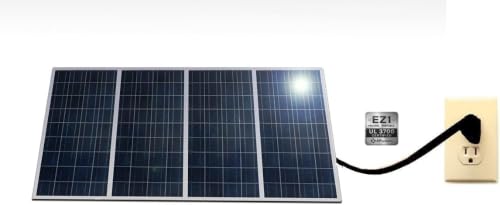 PluggedSolar 800 W plug-in balcony solar kit (4 panels) PluggedSolar 800 W plug-in balcony solar kit (4 panels)Four 200 W panels, an APsystems microinverter, a 50 ft cord for a 110/120 V outlet, app monitoring | 800 W of panels | The maker says the kit is UL 3700 certified for plug-in use and the microinverter meets UL 1741. | No. It shuts off. | PluggedSolar | $1,795 at Amazon |
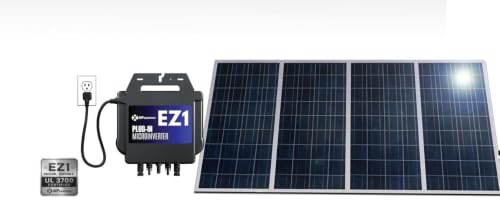 PluggedSolar 1,200 W plug-in balcony solar kit (6 panels) PluggedSolar 1,200 W plug-in balcony solar kit (6 panels)Six 200 W panels, APsystems microinverter, a 50 ft cord for a 110/120 V outlet, app monitoring | 1,200 W of panels | The maker says the kit is UL 3700 certified for plug-in use. | No. It shuts off. | PluggedSolar | $2,690 at Amazon |
| EcoFlow STREAM Microinverter (with or without EcoFlow panels) A 1,200 W, 120 V plug-in microinverter; EcoFlow also sells it with one, two or four 400 W panels | 1,200 W inverter | EcoFlow says UL 1741. Its page does not claim UL 3700. | No. It shuts off. | EcoFlow EcoFlow says it sells it for Utah only. $369 on the maker’s US store, October 14, 2026 | Sold in the US, not on Amazon |
| EcoFlow STREAM Ultra (battery with a built-in plug-in inverter) A 1.92 kWh battery with a built-in inverter; panels sold separately | 800 W inverter, 1,920 Wh battery | EcoFlow says UL 1741 and IEEE 1547. | Some: its battery can run a few essentials. | EcoFlow EcoFlow says it sells it for Utah only. | Sold in the US, not on Amazon |
| Bright Saver Balcony Solar Kit (180 W or 360 W) One or two 180 W flexible panels and a Hoymiles HiFlow Pro LV 360 W microinverter with a 15 ft cord | 360 W of panels | The microinverter is UL 1741 and UL 3700 compliant; Bright Saver says the whole kit does not yet have UL 3700 system certification. | No. It shuts off. | Bright Saver Ships to Utah, Virginia, Colorado, Maryland, Connecticut, New Hampshire and New Jersey. $499 on the maker’s US store, October 14, 2026 | Sold in the US, not on Amazon |
| Mango Power S 1,200 W plug-in solar kit Four 300 W panels, microinverters, a stand, cables and a zero-export gateway | 1,200 W of panels | The maker lists UL 1741-SA/SB, IEEE 1547 and CSA C22.2 on the product page. | No. It shuts off. | Mango Power $2,698 on the maker’s US store, October 14, 2026 | Sold in the US, not on Amazon |
| APsystems EZ1 plug-in microinverter (inverter only) A two-panel plug-in microinverter with a 5 m cord; panels not included | Not stated | APsystems says CSA certified to UL 3700. | The maker does not say | APsystems $325 on the maker’s US store, October 14, 2026 | Sold in the US, not on Amazon |
| CraftStrom 1,200 W Eco-Line plug-and-play kit Six 200 W panels, three 400 W inverters, mounting and a smart power meter | 1,200 W of panels | The maker says its inverters are 'UL certified' and the kits are 'Legal in all 50 states'. The state laws we read do not support the 50-state claim. | The maker does not say | CraftStrom | Sold in the US, not on Amazon |
| Anker SOLIX Solarbank 2 E1600 (balcony battery) A 1.6 kWh battery with a built-in microinverter (European version) | 1,600 Wh battery | No US listing claim found | The maker does not say | Anker SOLIX | Not sold in the US yet |
| EcoFlow STREAM AC Pro and PowerStream (European balcony units) European 230 V balcony battery and microinverter | 1,920 Wh battery | No US listing claim found | The maker does not say | EcoFlow | Not sold in the US yet |
| Zendure SolarFlow 800 and Hyper 2000 (European balcony units) European balcony battery and inverter | Not stated | No US listing claim found | The maker does not say | Zendure | Not sold in the US yet |
| Jackery SolarVault (European balcony battery) European balcony battery | Not stated | No US listing claim found | The maker does not say | Jackery | Not sold in the US yet |
“Maker says” is the maker’s own claim, quoted from its page. We did not test these kits, and a listing claim is not a safety guarantee. Not on the list:
- PluggedSolar 1,600 W kit: Its 1,600 W of panels is over the 1,200 W cap in most of the state laws we read.
- PluggedSolar's older 800 W kit: Its maker page names UL 1741 for the inverter, not UL 3700, the standard several state laws name.
- Unbranded 800 W to 1,200 W grid-tie microinverters on Amazon: They are bare inverters with no panels, and we could not confirm a US plug-in safety listing for any of them.
Questions people ask
Is plug-in solar legal in my state?
Check the state table on this page. If your state is not in it, there is no plug-in solar law there yet, and your utility’s normal rules for home solar apply. Those usually mean an interconnection agreement. Call your utility before you plug anything in.
Is balcony solar the same as plug-in solar?
Yes. Balcony solar is the European name. The laws call it a portable solar generation device or a plug-in solar system. It is the same idea: a small kit that plugs into a regular outlet.
Does plug-in solar work during a power outage?
No, not by itself. Every kit we list that has no battery shuts off when the grid goes down, and most of the laws require that. If you want power in an outage, look at a power station with a solar panel instead.
How much can a plug-in solar panel save?
It depends on your sun, how you mount it and your price per kWh. An 800 W kit made about 794 to 1,434 kWh a year in the cities we modeled. Multiply that by your price per kWh, then subtract any power you send back to the grid, which most of these laws do not pay for.
Do I need permission from my landlord or HOA?
It depends on the state. Colorado (from January 1, 2027), New Jersey, Vermont and Virginia limit when a landlord can say no, and Colorado and New Jersey limit HOAs too. The other laws do not cover it, so your lease or HOA rules still apply.
What is UL 3700?
UL 3700 is UL’s safety outline written for plug-in solar. Maine, New Jersey and Vermont name it in their laws. Look for a kit whose whole system is listed, not just the inverter.
Sources
- Colorado: HB26-1007, read October 14, 2026
- Connecticut: HB 5340 (Public Act 26-127), read October 14, 2026
- Maine: LD 1730 (Public Law ch. 644), read October 14, 2026
- Maryland: HB 1532 (Chapter 353), read October 14, 2026
- Utah: HB 340 (2025), read October 14, 2026
- Vermont: S.202 (Act 149), read October 14, 2026
- California: SB 868 (Chapter 985), read October 14, 2026
- New Hampshire: SB 540 (Chapter 262), read October 14, 2026
- Virginia: HB 395 / SB 250 (2026), read October 14, 2026
- New Jersey: S2368 / A4836, Garden State Balcony Solar Act, read October 14, 2026
- Virginia: second source, read October 14, 2026
- New Jersey: second source, read October 14, 2026
- New York: S8512C / A9111, read October 14, 2026
- UL Solutions: plug-in solar certification program (UL 3700), read October 14, 2026
- NREL PVWatts v8 (National Laboratory of the Rockies API), read October 14, 2026
- U.S. Energy Information Administration, Electric Power Monthly, Table 5.6.A, average residential price, July 2026, read October 14, 2026
- PluggedSolar: PluggedSolar 800 W kit, read October 14, 2026
- EcoFlow: EcoFlow STREAM Microinverter, read October 14, 2026
- EcoFlow: EcoFlow STREAM Ultra, read October 14, 2026
- Bright Saver: Bright Saver kit, read October 14, 2026
- Mango Power: Mango Power S kit, read October 14, 2026
- APsystems: APsystems EZ1, read October 14, 2026
- CraftStrom: CraftStrom 1,200 W kit, read October 14, 2026
- Anker SOLIX: Anker SOLIX Solarbank, read October 14, 2026
- EcoFlow: EcoFlow STREAM AC Pro / PowerStream, read October 14, 2026
- Zendure: Zendure SolarFlow, read October 14, 2026
- Jackery: Jackery SolarVault, read October 14, 2026
Related: power stations for home backup · solar panels for a power station · connecting a power station to your house · safety rules.
PluggedSolar 800 W plug-in balcony solar kit (4 panels)On Amazon US
$1,795 at Amazon