The best backup power for a well pump
A well pump is the hardest start in an ordinary house, and it is wired in at 240 volts rather than plugged into anything. That is why this plan usually lands on a generator, and why every figure here is sized on the harder end of its range.
Buy the Westinghouse WGen9500DF: it clears the pump's worst-case starting surge with margin, puts out 240 volts, and is the only pick here with a retail listing whose model number matches our record. The Anker SOLIX F3800 is the route for anyone who cannot run an engine, making split-phase 240 volts from a single box, though it covers a 24-hour outage at the efficient end only. The Champion 201176 9000W Tri-Fuel Open Frame Inverter is the tri-fuel upgrade with more headroom, and we could not verify a listing for it, so this page carries no price for it.
The Amazon links on this page are affiliate links: if you buy through one we may earn a commission, at no extra cost to you. It does not change which units are picked. How that works.
| Model | Usable | Output | Short of worst case | Weight | Price | |
|---|---|---|---|---|---|---|
| Our pick | Westinghouse WGen9500DF | runs on fuel | 9,500 W | fuel, not battery | 211 lb | on Amazon |
| The battery route | Anker SOLIX F3800 | 3,264 Wh | 6,000 W | 12,816 Wh | 132 lb | on Amazon |
| More headroom, three fuels | Champion 201176 9000W Tri-Fuel Open Frame Inverter | runs on fuel | 7,250 W | fuel, not battery | 166 lb | no verified listing |
Who this is for
You are on a well, so when the power goes the water goes with it: no tap, no shower, no second flush. You want the pump back, along with the fridge and a few lights, for about a day, and you have somewhere outdoors, well clear of the house, for a machine to sit and run.
You also accept that reaching the pump means an electrician, because it is wired in rather than plugged in. If all you want is the fridge, the router and a few lamps, our page on portable power stations for home backup covers that indoors with nothing to start. If the motor worrying you is a sump pump in a basement pit, that has its own page. And if an engine is out of the question where you live, go straight to the battery pick.
How much battery you need
Two numbers come out of this plan; one decides everything. Keeping it all running takes 815 to 2,780 watts, which is the easy part. Starting the pump takes 2,115 to 6,780 watts for a split second, and a machine sized to the running total does not run the pump weakly, it stalls. A well pump is the hardest start in an ordinary house, and that surge is the number you shop on.
The range is that wide because well pumps are. They run from a half-horsepower shallow pump to a two-horsepower deep submersible, and the surge scales with the motor; depth is the other half, since a deeper pump lifts water further. Your own figure is set by the nameplate and the control box, which is where a soft start lives if the pump has one. The answer is in the well house, not on this page.
We size on the top of that range. Of the 58 units we evaluated, 12 are workable at all, 3 clear the plan outright and 9 clear the easy end only. A generator usually wins here because it is sold by the watt: it survives the surge and then gets fed. A battery must survive the surge and hold the whole day too, and across 24 hours the pump and the fridge split this plan's energy almost evenly, the lights barely registering. So the battery route below is for people who cannot run an engine.
Find your own fridge on that range. The yellow EnergyGuide label inside the door, or the model page on the maker’s site, gives kilowatt-hours per year. Enter it and we place your fridge in this plan. The federal test runs at a fixed room temperature with the doors shut, so the label is your fridge’s floor, not its average.
Adjust this plan to your house. Change the hours or the loads and the picks are re-scored here, with the same planner and the same maker figures.
Where the energy goes, load by load
| Load | Hours | Running watts | Duty cycle | Energy | Share of worst case |
|---|---|---|---|---|---|
| Refrigerator/freezer | 24 | 100–700 | 20–50% | 480–8,400 Wh | 52% |
| Well pump | 24 | 700–2,000 | 2–15% | 336–7,200 Wh | 45% |
| A few LED lights | 8 | 15–80 | 25–75% | 30–480 Wh | 3% |
Energy = running watts × duty cycle × hours, at each end of the range. The right-hand end of every row is what the plan is sized on.
A well pump, a refrigerator and a few LED lights for 24 hours, run against all 58 units we track: 12 clear at least the best case, 45 do not, and 1 could not be judged (a missing maker figure or an unresolved recall identity). Every figure is from the maker’s own page or manual; nothing here was tested by us. The method.
Our pickWestinghouse WGen9500DF
The one that starts it, at a price we can verify
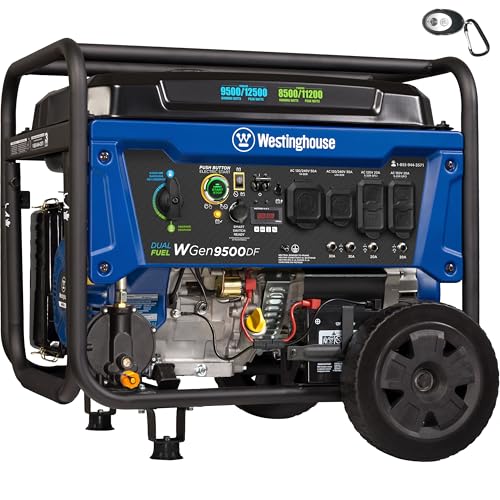
$999 at Amazon, September 16, 20269,500 W continuous12,500 W peak211 lbgasoline, propane
The Westinghouse WGen9500DF clears the worst-case start with margin on Westinghouse's own peak rating, makes both 120 and 240 volts, and carries the twist-lock outlet that an inlet or transfer-switch cord plugs into. It runs on gasoline or propane, and it is the only pick on this page with a listing whose model number matches our record, which makes it the only one we can put a price against. It suits a household with room outdoors for an engine that wants the pump back without doing arithmetic about margins.
The listing we verified as the bare unit; the price is on Amazon.
A well pump, a refrigerator and a few LED lights for 24 hours:
- Running loadyes, even in the worst case
- Starting surgeyes, even in the worst case
Living with it
It starts three ways: a push button, a wireless remote fob, and a recoil cord for a flat battery. Carbon monoxide is the weak spot. This version has no CO sensor and no automatic shutdown: Westinghouse's own spec sheet says so, reserving that feature for the near-identical WGen9500DFc, one letter apart. Do not let a shelf label blur the two, and keep battery alarms indoors.
The outlets are two GFCI household duplexes, a 120/240-volt thirty-amp twist-lock and a fifty-amp 120/240-volt socket, with no USB. The twist-lock is the point of this pick: it is what the inlet or transfer-switch cord goes into. The tank is the biggest here, with a gauge. Being open-frame rather than an inverter, its own spec table puts harmonic distortion high enough that sensitive electronics want a surge protector, and it is loud, on a figure with no stated distance or load.
Automatic low-oil shutdown is fitted; the oil chart changes grade with the season, four-stroke only. It is not parallel-capable as far as we can tell: the parallel kit's manual limits itself to inverter generators, an inference from that kit's scope rather than a flat statement. Never-flat wheels are fitted, and the warranty is three years residential. One forum poster reported a couple of hundred hours without trouble. Another describes the starter re-engaging on a running engine and throwing sparks, with a control-board swap that did not cure it: one report, not a pattern. Hard starting on propane recurs across threads, traced by owners to regulator pressure and the quick-connect fitting rather than the machine.
- Noise
- 74 dBA per maker; distance and load not specifiedwestinghouse.com
- Warranty
- 3 years residential, 1 year commercial; lifetime support linewestinghouse.com
- Starting
- Electric start with remote fob; recoil backup if battery dieswestinghouse.com
- CO shutoff
- None; no CO sensor - CO version is a separate SKU, WGen9500DFcwestinghouse.com
- Runtime at quarter load
- Up to 12 hours at 25% load on a full 6.6-gal tankwestinghouse.com
- On propane
- 9,500W gas vs 8,500W propane running (about 10% less)westinghouse.com
- Outlets
- Two GFCI 5-20R outlets, one L14-30R, one 14-50R; no USBwestinghouse.com
- Low-oil shutdown
- Yes, automatic low-oil shutdown includedwestinghouse.com
- Parallel
- No; parallel kit only fits Westinghouse inverter modelscdn.westinghouseoutdoorpower.com
What owners report, from public threads and long-term reviews; not our own testing.
- One owner reported the starter motor re-engaging while the engine was already running, causing sparks near the flywheel housing; a control-board replacement reportedly did not fully resolve the fault.powerequipmentforum.com
- Hard-starting or failure-to-start on propane is a recurring complaint on owner forums, usually traced to LPG regulator pressure or the quick-connect fitting rather than a defective unit.powerequipmentforum.com
- Some owners report the generator runs fine on one fuel but won't start on the other, which forum members trace to the fuel-selector solenoid or carburetor circuit rather than total failure.powerequipmentforum.com
- One long-term tester logged over 200 hours with no problems and liked the digital display showing voltage output and cumulative running hours.tractorbynet.com
What you give up
Carbon monoxide, weight and noise. It is the only pick here with no CO shutoff of any kind, it is a wheeling job rather than a lift, and being open-frame it is both the loudest of the three on the makers' own numbers and the dirtiest power. It cannot be paralleled either, so if it ever turns out too small, the answer is a different machine and not a second one.
Figures from westinghouse.com, captured August 11, 2026; recall screen: not screened against the recall database yet (how we screen, CPSC).
The battery routeAnker SOLIX F3800
The battery route
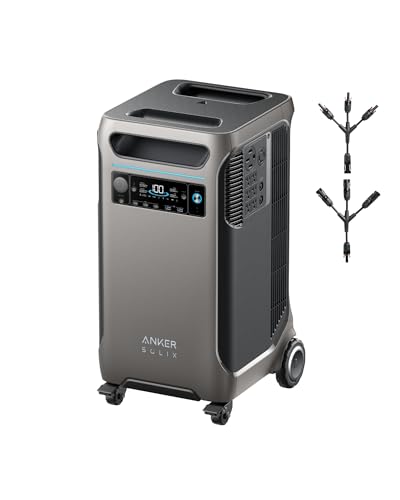
$2,200 at Amazon, September 16, 20263,840 Wh (3,264 usable)6,000 W continuous9,000 W peak132 lb
The Anker SOLIX F3800 is here for the household that cannot run an engine: a covered lot, a rented place, an ordinance, or lungs that will not take exhaust. It makes split-phase 240 volts from a single box, its peak rating covers this plan's start, and it does the job silently and indoors. What it will not do is the whole day, covering a 24-hour outage at the efficient end and not the hard end, so it suits short outages, or a roof with panels on it and sun in the forecast.
Against the worst case it is 12,816 Wh short: about 5.3 hours of full sun at its 2,400 W solar input, or roughly 64 hours from one 200 W panel, and real panels deliver less than their rating.
The listing we verified as the bare unit; the price is on Amazon.
A well pump, a refrigerator and a few LED lights for 24 hours:
- Energyonly in the best case
- Running loadyes, even in the worst case
- Starting surgeyes, even in the worst case
Living with it
It weighs what two people should carry. Reviewers who used it through real outages say the wheels and handle move it across a floor and no further: Pro Tool Reviews needed help getting it upstairs and into a vehicle after Hurricane Milton, and The Solar Lab says the wheels roll it into position rather than making it portable. Decide where it lives before it arrives.
It is quiet until it is not. The Solar Lab's testers found the fans cycling on and off unpredictably under light office loads while it stayed nearly silent under a much heavier kitchen load; Backup Power Hub's three-week test has them engaging past roughly two-fifths load, then climbing to something you notice in the room. A well pump is exactly that shape of load: nothing for an hour, then a heavy draw.
Change the standby timer before the storm: with the outputs on and nothing drawing, it powers itself off after about half a day, and a pump that has not run since bedtime looks like nothing. The duration is adjustable in the Anker SOLIX app, which one reviewer found reliable through an outage. It refills from a wall outlet fast enough to be worth topping up in a lull, on one reviewer's measurement, but will not charge below freezing: an unheated garage in January is the wrong home. Six expansion batteries stack behind it, and no published recall names it. One caveat from testing: measured inverter efficiency came in well under the rated figure, so it drains faster than the outlet numbers imply.
- Charges between
- 0°C to 40°C (32°F to 104°F) while chargingsignaturesolar.com
- Low-load shutoff
- Shuts off after about 12 h idle with no loadsignaturesolar.com
- Expansion
- Up to 6 add-on batteries, 26.88 kWh added capacityankersolix.com
What owners report, from public threads and long-term reviews; not our own testing.
- Multiple reviewers report fan noise climbs sharply under heavy load — about 68 dB at 90% load versus 58 dB at 50% load — despite near-silent operation at lighter loads.backuppowerhub.com
- The roughly 132 lb weight is a recurring complaint; reviewers needed a second person or a vehicle ramp to move it anywhere the built-in wheels couldn't roll it.protoolreviews.com
- One long-term tester measured real-world AC recharge at about 1 hour 38 minutes to 80% (roughly 2h21m full) on a standard outlet, slower than a quick top-up.backuppowerhub.com
- A 2-ton central air conditioner drained the unit in only about 1.6 hours despite its 6,000W rating, so it isn't a practical all-day whole-home AC backup alone.backuppowerhub.com
- One tester measured real-world inverter efficiency at only about 85%, meaning a 3,000W draw actually consumes roughly 3,530Wh from the battery — more than the rated draw implies.backuppowerhub.com
What independent testers measured
We do not test units ourselves. These are figures published by testers who did, with the maker’s claim beside them where the tester gave it.
| Measurement | Result | Tester |
|---|---|---|
| Wall charge, to 80% | 1 hour 38 minutes from 0-80% on a standard 120V/15A outlet (max 1,440W input) | Backup Power Hub |
| Wall charge, empty to full | 2 hours 21 minutes from dead to full via AC | Backup Power Hub |
| Inverter efficiency, measured | ~85% inverter efficiency, measured during testing | Backup Power Hub |
| Solar input achieved | 1,850W peak solar input achieved with three 400W panels in ideal conditions (maker: 2,400W rated solar input (per generatorchecker.com spec listing, not stated by this tester)) | Backup Power Hub |
| Noise under load, measured | 58 dB at 3 feet at 50% load (3000W) | Backup Power Hub |
| Noise under load, measured | 68 dB at 90% load (5400W), 'comparable to a dishwasher' | Backup Power Hub |
- After a three-week real-world test running central AC, refrigerators, and power tools, the reviewer rated the F3800 9.2/10, calling it the best split-phase 240V whole-home option currently on the market. (Editor's Choice (per site homepage listing, 9.2/10)) Backup Power Hub
- The reviewer calls the F3800 a solid investment at $3,499 for whole-home backup power or off-grid adventures, despite it being the heaviest single-unit station they've tested. The Solar Lab
What you give up
Energy, and the moving of it. It covers this plan at the efficient end only, the hard end of a 24-hour day being beyond it on one charge, and with the grid down its refill is a sky that a storm does not hand over freely. It is also the heaviest thing here that is not an engine, and it is much the most expensive way to start this pump.
Figures from ankersolix.com, captured August 12, 2026; recall screen: no published recall names this exact model (screened 2026-08-12) (how we screen, CPSC).
More headroom, three fuelsChampion 201176 9000W Tri-Fuel Open Frame Inverter
More headroom, three fuels
7,250 W continuous9,000 W peak166 lbgasoline, propane, natural_gas
The Champion 201176 9000W Tri-Fuel Open Frame Inverter clears the worst case with room over it and burns three fuels rather than two, adding natural gas to gasoline and propane. It is an inverter, so its power is cleaner than our pick's, and unlike our pick it has a carbon monoxide shutoff. Take it if the pump is one item on a longer list, or if the fuel flexibility matters more to you than a price we can verify.
No Amazon listing for the bare unit has passed our identity check, so no price and no Amazon link.
A well pump, a refrigerator and a few LED lights for 24 hours:
- Running loadyes, even in the worst case
- Starting surgeyes, even in the worst case
Living with it
Champion quotes runtime on a full tank at a quarter of rated load, as both generator makers do, and this one gets more out of less: the tank is smaller than our pick's and the quoted runtime is still longer, which is what an inverter engine throttling down to a light load buys you. A well pump idle most of the day is the load that benefits most from it.
The shutoff is Champion's CO Shield, which cuts the engine when carbon monoxide builds around it, and Champion states plainly that it is not a substitute for an indoor CO alarm. It makes 120 and 240 volts, which is the part this plan needs. It is lighter than our pick, though not so much lighter that it stops being a wheeling job.
Past that we have little to tell you. Our dossier carries no warranty term for it, no recall screening, and no owner intel at all: no forum threads, no long-term reviews, nothing we would repeat to you. That is a gap in our research rather than a verdict on the machine, but it does mean that if you buy this one you are buying on the maker's own numbers, with nothing from anybody who has lived with it.
What you give up
The price we cannot give you. No listing we found matches this part number, so this page carries no figure for it, and Champion sells several similarly named machines, so match the part number rather than the marketing name when you go looking. There is also nothing owner-reported to set against the spec sheet, which on a machine bought to start a well pump in a storm is worth weighing.
Figures from championpowerequipment.com, captured August 11, 2026; recall screen: not screened against the recall database yet (how we screen, CPSC).
Day two and three
A generator has no runtime of its own; it runs as long as you feed it, so day two is a fuel question. Each maker quotes runtime on a full tank at a quarter of rated load, the figure on each card; this plan sits near that mark because the pump is idle most of the day. Count the refuels that implies across a 24-hour outage, and buy the cans before the storm.
Propane is the reason to look at the dual-fuel and tri-fuel picks: it keeps for years and starts a machine that has sat since the last outage. It costs output: on Westinghouse's own figures the Westinghouse WGen9500DF gives up roughly a tenth of its running and peak watts on propane. The Champion 201176 9000W Tri-Fuel Open Frame Inverter adds natural gas, and a house already on a gas line has no refuelling problem at all. The battery's day two is a charging problem instead: with the grid down, its refill is the sun.
Hooking it up safely
The pump is wired in, so there is no cord to move and no socket to use. Three things can reach it, and all of them are permit work. An inlet box outside plus an interlock on the panel, a plate that physically stops the main breaker and the generator breaker being on together, lets you feed any circuit in the panel as long as the total stays inside what the machine can produce. A manual transfer switch instead gives you a small sub-panel of circuits chosen in advance and switched by hand. Or a meter-collar device such as GenerLink sits behind the electric meter rather than in the panel and reaches the whole panel, which its maker contrasts with the handful of circuits it says a traditional switch limits you to. None of it is yours to fit: Reliance says its inlet boxes must be installed by a qualified electrician to code and its generator-ready panels are not a do-it-yourself job, GenerLink says the same about a licensed electrician or the utility, and a permit is required the moment a transfer switch or interlock goes in, with building departments expecting a licensed electrician to sign the electrical subpermit.
What you must never do is feed the house through an outlet. Backfeeding a panel is illegal under the National Electrical Code and in many jurisdictions besides, and Generac's safety note is blunt about why: line workers treat a dead line as dead, and power arriving from your house can injure or kill them. It can also collide with returning utility power and start a fire. A 240-volt socket on a battery changes none of this. EcoFlow's own manual tells owners not to connect a power station to a building's electrical system without a properly installed isolation switch, and Anker's support pages add that on the US F3800 the 240-volt ports do not work at all while the unit is running in UPS mode; the switch, not the outlet, is what opens the connection to the grid. And the engine stays outdoors. The CPSC says outdoors only, at least 20 feet from the house, with the exhaust pointed away from windows, doors and vents.
Buying it right
A search for any of these models returns bundles, sibling models and, often, the same unit under two listings at different prices. We link only a listing whose own title states the bare unit and its exact battery and output; the box should say the same. Check the seller is the maker or Amazon itself, and that the model number on the label matches the one on this page.
Westinghouse WGen9500DF
- The listing we verified: “Westinghouse 12500 Watt Dual Fuel Home Backup Portable Generator, Remote Electric Start, Transfer Switch Ready, Gas and Propane Powered”, $999 when checked. Listing's own model number is WGen9500DF, matching our record's part number exactly.
- “Westinghouse Outdoor Power Equipment WGen Generator Cover - Universal Fit For Portable Generators Up to 9500 Rated Watts”, $17: Listing is an accessory or part that names this model, not the unit itself..
- “Natural Gas Conversion Kit fits Westinghouse WGEN9500DF Generator”, $130: a bundle, not the bare unit; the extra hardware is in the price.
Anker SOLIX F3800
- The listing we verified: “Anker SOLIX F3800 Portable Power Station, 3,840Wh”, $2,200 when checked. Title states 3840Wh and the exact model name with no variant word; it does not state a wattage, so output was not cross-checked against our 6000W record. (previously verified ASIN, re-checked by direct lookup)
- “Anker SOLIX F3800 Portable Power Station and 400W Solar Panel, 3,840Wh”, $2,400: a bundle, not the bare unit; the extra hardware is in the price.
- “Anker SOLIX F3800 Portable Power Station, 3840Wh, LiFePO4 Batteries, Ultra-High 6000W AC Output with 120V/240V, Solar Generator for Home Backup and Outdoor Camping (Renewed)”, $1,759: Listing is renewed/refurbished, not the new base unit..
Champion 201176 9000W Tri-Fuel Open Frame Inverter
- “Champion 12,500-Watt Electric Start Tri Fuel Home Backup Portable Generator”, $1,260: Listing's model number is '201438' and the title does not carry the part number '201176'..
- “Champion 8500-Watt Remote Start Tri Fuel Portable Inverter Generator”, $1,545: Listing's model number is '201537' and the title does not carry the part number '201176'..
- “Champion 8125-Watt Electric Start Tri Fuel Portable Generator”, $999: Listing's model number is '201169' and the title does not carry the part number '201176'..
- “Champion 11,000-Watt Electric Start Dual Fuel Portable Inverter Generator”, $2,235: Listing's model number is '201417' and the title does not carry the part number '201176'..
- “Champion 11,000-Watt Remote Start Tri Fuel Portable Inverter Generator”, $2,000: Listing's model number is '201423' and the title does not carry the part number '201176'..
What this page can’t promise
This page sizes machines against a modelled well pump, not against yours. Horsepower, depth and the control box set the surge, and the nameplate in your well house is the only place that number lives. If it sits above our range, everything here moves up a size.
Nothing here was tested by us. The figures are the makers' own, read off their pages and manuals and cited under each pick, and where a marketing page and its manual disagree we say so rather than take the better number. Owner reports come from public forum threads and review sites, labelled as such; some were readable only through search snippets. Two of the three are not yet screened against the recall database.
The competition
Every unit we track was run against the same plan. The ones that clear at least the best case are below with their own shortfall; the ones that do not are listed with the rule they fail.
Every unit that clears at least the best case (12)
| Model | Battery | Peak | Weight | Worst-case shortfall | Verified price | Verdict |
|---|---|---|---|---|---|---|
| Champion 201598 8500W Wireless Start Tri Fuel Inverter | not captured | 8,500W | 132 lb / 60.0 kg | not published | no verified listing | Clears the numbers |
| Champion 201176 9000W Tri-Fuel Open Frame Inverter | not captured | 9,000W | 166 lb / 75.2 kg | not published | no verified listing | Clears the numbers |
| Westinghouse WGen9500DF | not captured | 12,500W | 211 lb / 95.7 kg | not published | $999 | Clears the numbers |
| Zendure SuperBase V6400 | 6,438Wh | 5,000W | not captured | 10,608 Wh | no verified listing | Clears the best case only |
| Jackery Explorer 5000 Plus | 5,040Wh | 14,400W | 134 lb / 61.0 kg | 11,796 Wh | no verified listing | Clears the best case only |
| Zendure SuperBase V4600 | 4,608Wh | 5,000W | 55 lb / 25.0 kg | 12,163 Wh | no verified listing | Clears the best case only |
| EcoFlow DELTA Pro 3 | 4,096Wh | 8,000W | 114 lb / 51.5 kg | 12,598 Wh | $3,699 | Clears the best case only |
| Anker SOLIX F3800 | 3,840Wh | 9,000W | 132 lb / 60.0 kg | 12,816 Wh | $2,200 | Clears the best case only |
| Anker SOLIX F3800 Plus | 3,840Wh | 9,000W | 132 lb / 60.0 kg | 12,816 Wh | no verified listing | Clears the best case only |
| Jackery HomePower 3600 Pro Max | 3,600Wh | not captured | not captured | 13,020 Wh | no verified listing | Clears the best case only |
| BLUETTI Apex 300 Home Battery Backup | 2,765Wh | 7,680W | 84 lb / 38.0 kg | 13,730 Wh | no verified listing | Clears the best case only |
| Champion 201513 6500W Inverter | not captured | 6,500W | 102 lb / 46.3 kg | not published | no verified listing | Clears the best case only |
What will not work, and why (45)
- Goal Zero Yeti PRO 4000 — Your plan needs 240V output. This unit supplies 120V.
- EcoFlow DELTA Pro — Your plan needs 240V output. This unit supplies 120V.
- Jackery HomePower 3600 Plus — Your plan needs 240V output. This unit supplies 120V.
- Anker SOLIX F3000 (UL9540 Certificated) — Your plan needs 240V output. This unit supplies 120V.
- EcoFlow DELTA 3 Ultra (3072Wh) — Your plan needs 240V output. This unit supplies 120V.
- Jackery HomePower 3000 — Your plan needs 240V output. This unit supplies 120V.
- EcoFlow DELTA 3 Ultra Plus (3072Wh) — Your plan needs 240V output. This unit supplies 120V.
- Anker SOLIX F2600 — Your plan needs 240V output. This unit supplies 120V.
- Zendure SuperBase Pro 2000 — Your plan needs 240V output. This unit supplies 120V.
- Anker SOLIX C2000 Gen 2 — Your plan needs 240V output. This unit supplies 120V.
- EcoFlow DELTA 2 Max — Your plan needs 240V output. This unit supplies 120V.
- EcoFlow DELTA 3 Max (2048Wh) — Your plan needs 240V output. This unit supplies 120V.
- Jackery HomePower 2000 Plus v2 — Your plan needs 240V output. This unit supplies 120V.
- BLUETTI AC200L — Your plan needs 240V output. This unit supplies 120V.
- EcoFlow DELTA 3 Max Plus (2048Wh) — Your plan needs 240V output. This unit supplies 120V.
- Jackery Explorer 2000 Plus — Your plan needs 240V output. This unit supplies 120V.
- Jackery Explorer 2000 v2 — Your plan needs 240V output. This unit supplies 120V.
- PECRON E2000LFP — Your plan needs 240V output. This unit supplies 120V.
- Jackery Explorer 1500 Ultra — Your plan needs 240V output. This unit supplies 120V.
- Jackery Explorer 1500 v2 — Your plan needs 240V output. This unit supplies 120V.
- Jackery Explorer 1000 Plus (JE-1000C) — Your plan needs 240V output. This unit supplies 120V.
- Jackery Explorer 1000 v2 — Your plan needs 240V output. This unit supplies 120V.
- Anker SOLIX C1000 — Your plan needs 240V output. This unit supplies 120V.
- Jackery HomePower 1000 v2 — Your plan needs 240V output. This unit supplies 120V.
- EcoFlow DELTA 3 Plus — Your plan needs 240V output. This unit supplies 120V.
- EcoFlow DELTA 3 Classic (1024Wh) — Your plan needs 240V output. This unit supplies 120V.
- EcoFlow DELTA 3 — Your plan needs 240V output. This unit supplies 120V.
- BLUETTI Elite 100 V2 — Your plan needs 240V output. This unit supplies 120V.
- EcoFlow DELTA 2 (EFD330) — Your plan needs 240V output. This unit supplies 120V.
- Anker SOLIX C1000 Gen 2 — Your plan needs 240V output. This unit supplies 120V.
- Jackery Explorer 600 v2 — Your plan needs 240V output. This unit supplies 120V.
- BLUETTI AC50B — Your plan needs 240V output. This unit supplies 120V.
- Anker SOLIX C300 DC — Your plan needs 240V output. This unit supplies 120V.
- Jackery Explorer 300D — Your plan needs 240V output. This unit supplies 120V.
- Anker SOLIX C300 — Your plan needs 240V output. This unit supplies 120V.
- Jackery Explorer 300 v2 — Your plan needs 240V output. This unit supplies 120V.
- EcoFlow RIVER 3 Plus — Your plan needs 240V output. This unit supplies 120V.
- EcoFlow RIVER 3 — Your plan needs 240V output. This unit supplies 120V.
- Anker SOLIX C200 DC — Your plan needs 240V output. This unit supplies 120V.
- Honda EU2200i Super Quiet Inverter Generator — Your plan needs 240V output. This unit supplies 120V.
- Honda EU3000iS Inverter Generator — Your plan needs 240V output. This unit supplies 120V.
- FIRMAN WH03242 Dual-Fuel Inverter — Your plan needs 240V output. This unit supplies 120V.
- Champion 201444 5500W Inverter — Your plan needs 240V output. This unit supplies 120V.
- Champion 201255 5500W Open Frame Inverter (CARB) — Your plan needs 240V output. This unit supplies 120V.
- Champion 201254 5500W Dual Fuel Open Frame Inverter (CARB) — Your plan needs 240V output. This unit supplies 120V.
Questions people ask
How many watts does it take to start a well pump?
In this plan, 2,115 to 6,780 watts for a split second, against 815 to 2,780 watts to keep everything running afterwards. Where your own pump falls in that span comes down to its horsepower and how deep it sits. The surge is what decides the purchase; the running watts are the easy part, and a machine that covers only those will stall the moment the pump kicks in.
Can a power station run a well pump, or do I need a generator?
A power station can, provided it makes split-phase 240 volts and its peak rating covers your pump's surge. The Anker SOLIX F3800 does both. The catch is the day rather than the start: it covers a 24-hour outage at the efficient end only, and with the grid down the refill is sunshine. A generator is fed rather than charged, which is why it usually wins this plan. Buy the battery if an engine is not an option where you are.
Can I just plug the generator into a socket in the house?
No. Pushing power backward through an outlet is backfeeding, it is illegal under the National Electrical Code, and Generac's own safety note explains the cost: line workers treat a dead line as dead, and power arriving from your house can injure or kill them. It can also clash with returning utility power, start a fire, or wreck the generator. There is no version of this that is acceptable for one night.
Do I need an electrician and a permit for the hookup?
Yes to both. A permit is required the moment a transfer switch or interlock is installed, and building departments generally expect a licensed electrician to sign the electrical subpermit and carry responsibility for code compliance. The makers say the same: Reliance states its inlet boxes must be installed by a qualified electrician, and GenerLink states its meter collar must be fitted by a licensed electrician or by the utility. Budget for that work alongside the machine.
Does the generator have to run all day, or only when we want water?
The pump itself draws for only a small share of the 24 hours in this plan; it is the fridge that keeps asking. You can run the engine in stretches and shut it down between them, and each maker's quarter-load runtime tells you what a tankful buys. Remember that everything else stops when it does, so the fridge on a warm day sets the longest gap you can afford.
Other plans we sized
- Home backupThe best portable power stations for home backup
A fridge, the internet, a few lamps and everyone's phones through a day without the grid, indoors, with no engine to run. Sized on the harder end of every range.
- Camping and road tripsThe best portable power stations for camping
Two nights of phones, a laptop and a few lights is a small job with a wide range, and the range is what catches people out. All three picks cover the easy end of it on one charge; the hard end takes a panel at the site or a full charge before you leave.
- CPAPPortable power for a CPAP machine: one night, and three
A CPAP is a small, steady load, so this comes down to battery size and one switch: the heated humidifier. Covering a single night is settled; covering three, or running the heat, takes a bigger box.
- Portable generatorsThe best portable generators for home backup
Three generators judged on the one number that decides the job: the watts on tap for the second a fridge and a chest freezer both restart at once. Not battery capacity, and not the running total.
- ComparedThe home-backup class: DELTA Pro 3, SOLIX F3800, Explorer 5000 Plus and the rest
The largest portable power stations on one table, run against a full-day household plan, with expansion paths, 240V output and the makers' gaps marked.
- RefrigeratorHow much battery it takes to run a refrigerator, and which power station does it
A fridge is the appliance everyone wants kept running, and the one whose appetite varies most from house to house. Size it on the harder end of that range and the choice of station mostly makes itself.
- Sump pumpThe best portable power stations for a sump pump
A sump pump is a motor that starts hard and then runs in bursts: the starting surge decides which station can start it at all, and the weather decides how much energy it drinks. Sized on the harder end of every range.
- FurnaceThe best portable power stations for a gas furnace
A gas furnace burns its own fuel and asks the grid only for the blower and the control board, which is the good news. The bad news is that both are wired into the house, so the battery is half the job and an electrician is the other half.
- ComparedAnker SOLIX F3800 vs F3800 Plus: the real differences
The Anker SOLIX F3800 and F3800 Plus side by side from Anker's own figures, judged against one full-day household plan, with the real differences marked.
- Camping with a fridgeThe best portable power stations for camping with a fridge
Put a compressor fridge in the back of the car and it becomes most of the battery: it is the one thing in your kit that keeps drawing while you sleep. We size this page from the hard end of every range.
- GuidePower station or generator: which do you actually need?
This is the decision that comes before choosing a product, and it is the expensive one to get wrong in either direction. A battery bought for a well pump is wasted money; a standby generator bought to keep a router alive is a great deal more of it.
- GuideHow to connect a power station to your house
These four methods differ less in how much power they move than in what they can reach: a cord reaches a plug, transfer equipment reaches a circuit. The fifth thing people try, a cord into a wall socket, can kill the line worker restoring your power.
- GuideSolar panels for a power station: how many, and how long
Panels are where the optimism creeps into a backup plan. The arithmetic is simple enough to do on the back of an envelope, and the answer it gives you is the best case, not the likely one.
- GuideExpansion batteries: what an extra battery for a power station actually does
An extra battery for a power station is the cheapest-sounding fix for the wrong problem about half the time. It buys hours, it does not buy watts, and the pack you buy has to be the exact one your station was built for.
Westinghouse WGen9500DFOur pick
Check price at Amazon