What size generator do you need for 200 amp service?
A 200-amp house needs a generator with at least 6,060 running and 10,060 starting watts for the essentials, well pump included. Whole house with central air: 18 to 22 kW (Generac).
Affiliate links: we may earn a commission, at no cost to you. How that works.
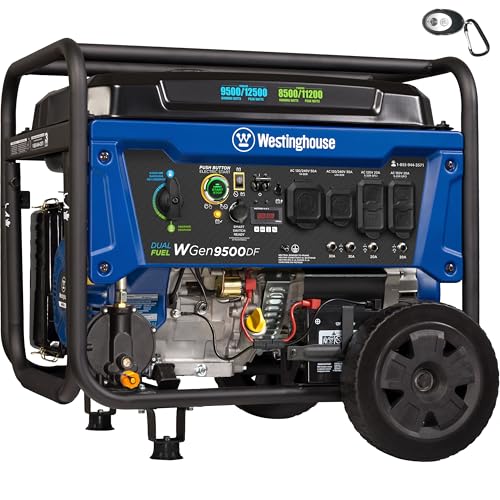
Westinghouse WGen9500DF: $999, checked October 12, 2026
Dual fuel, 240 V: 9,500 running / 12,500 peak watts on gas, 8,500 / 11,200 on propane. Transfer-switch ready.
Generator size by what you want to run
| What you run | Running watts | Starting peak | Generator to buy |
|---|---|---|---|
| Fridge, freezer, lights, Wi-Fi and phones | 0.2 kW–1.4 kW | up to 3.6 kW | at least 1.4 kW running, 3.6 kW starting |
| Plus a gas furnace blower and a sump pump | 1.3 kW–4.1 kW | up to 7.1 kW | at least 4.1 kW running, 7.1 kW starting |
| Plus a 240 V well pump | 2.0 kW–6.1 kW | up to 10.1 kW | at least 6.1 kW running, 10.1 kW starting, 240 V |
| Plus a window air conditioner and a microwave | 3.3 kW–11.1 kW | up to 15.1 kW | at least 11.1 kW running, 15.1 kW starting, 240 V |
| Whole house with a 3-ton central air conditioner | AC alone 3.5–5 kW | AC alone up to 15–18 kW | 18–22 kW standby (Generac), or smaller with load managers |
| Everything on a 200 A panel at once | 48 kW | — | Nobody runs this. It is the panel’s limit. |
Why not 48 kW? 200 A × 240 V = 48 kW is the most the panel can carry, not what a house uses at once. The first four rows come from the appliance figures on our load pages: running watts at the easy and hard end, all running at once, plus the biggest motor’s start at the hard end. Central air figures are Generac’s (Generac sizing guide).
The load math, step by step
- List what must run. For most homes: fridge, freezer, furnace blower (gas heat), sump pump, well pump, lights, Wi-Fi.
- Add the running watts. All of them at once comes to 6,060 W at the hard end (2,020 W at the easy end).
- Add the biggest start. A motor pulls several times its running watts for a second as it starts. The hardest here is the well pump. With everything else running, that start peaks at 10,060 W.
- Buy a generator above both numbers. At least 6,060 running watts and 10,060 starting watts, with 240 V for the well pump.
| Appliance | Running | Starting, hard end | Volts |
|---|---|---|---|
| Refrigerator/freezer | 100–700 W | 2,900 W | 120 V |
| Chest freezer | 80–500 W | 2,200 W | 120 V |
| Gas-furnace blower | 400–1,200 W | 3,500 W | 120 V |
| Sump pump | 700–1,500 W | 4,500 W | 120 V |
| Well pump | 700–2,000 W | 6,000 W | 240 V |
| A few LED lights | 15–80 W | 80 W | 120 V |
| Wi-Fi router and modem | 15–40 W | 40 W | 120 V |
| Phone charging and small USB devices | 10–40 W | 40 W | 120 V |
No well pump? Then 4.1 kW running and 7.1 kW starting covers it, and you do not need 240 V for this list. Electric water heaters, ranges and dryers each draw several kilowatts; leave them off a portable generator.
What the electrical code says
The National Electrical Code (NEC) treats a home generator as an “optional standby system” (Article 702). Its size rule depends on who picks the loads.
- You switch loads by hand (a manual transfer switch or an interlock): the generator only has to carry what you choose to run. The code: “Where manual transfer equipment is used, an optional standby system shall have adequate capacity and rating for the supply of all equipment intended to be operated at one time. The user of the optional standby system shall be permitted to select the load connected to the system.” (NEC 702.4, quoted by North Carolina’s Office of State Fire Marshal; 702.4(A)(1) in the 2023 edition). That is why a portable generator can back up a 200 A house.
- An automatic transfer switch picks for you: “(a) Full Load. The standby source shall be capable of supplying the full load that is automatically connected.” Or a load manager must hold the load to what the generator can carry. The code panel put it plainly: “The NEC clearly prohibits an optional standby system installation that will transfer automatically to more load than it can supply.” This is why whole-house standby units are sized to the house, or sold with load managers.
Connect it with a transfer switch, never a wall outlet
A licensed electrician fits a transfer switch or an interlock and an inlet box. Then you plug the generator into the inlet with one cord. Which switch fits the Westinghouse WGen9500DF:
- 30 A, the L14-30R outlet: the Reliance Controls 310CRK ten-circuit transfer switch kit (switch, inlet box and cord in the box). A 30 A connection carries at most 30 A × 240 V = 7,200 W, less than the Westinghouse WGen9500DF’s 9,500 W. Reliance Controls 310CRK ten-circuit transfer switch kit: $475 at Amazon
- 50 A, the 14-50R outlet: the Reliance Controls A510A ten-circuit 50 amp transfer switch. 50 A × 240 V = 12,000 W, so the generator’s full output reaches the house. Reliance Controls A510A ten-circuit 50 amp transfer switch: $499 at Amazon
Prices checked October 12, 2026. Every switch, kit and inlet we track, with what fits each: generator transfer switch guide.
What goes wrong
- Lights dim and the well pump will not start. The starting peak is above the generator’s. Start the biggest motor first, with little else running.
- The 30 A cord trips. An L14-30 connection tops out at 7,200 W even on a bigger generator. Use the 50 A outlet and a 50 A switch.
- Carbon monoxide. The CPSC says: “Never run generators indoors, including garages, basements, crawlspaces and sheds.” (CPSC). Keep it outside, away from windows and doors, and fit CO alarms.
- Backfeeding. Plugging a generator into a wall outlet to feed the house can electrocute a line worker. Use a transfer switch or interlock.
- Propane in the cold. On propane this generator gives 8,500 running watts, not 9,500.
Who should buy which
- Essentials with a well pump, on a budget: a 6–10 kW portable dual-fuel generator such as the Westinghouse WGen9500DF, plus a transfer switch fitted by an electrician.
- No well pump, gas heat: 4.1 kW running and 7.1 kW starting is enough.
- Central air and no hands-on switching: an 18–22 kW standby generator with an automatic transfer switch, sized by an electrician to the code’s load calculation. We do not track standby units.
- No fuel, quiet, indoors: a large battery. See our home backup power station guide.
Questions people ask
What size generator do I need for 200 amp service?
For the essentials, well pump included: at least 6,060 running watts and 10,060 starting watts, so a portable generator of about 6 to 10 kW. For the whole house with central air: about 18 to 22 kW. 200 A times 240 V is 48 kW, the panel's limit, not a generator size.
What size generator do I need for 100 amp service?
The same as for 200 amps: size it to what you run, not to the panel. The essentials with a well pump need about 6,060 running and 10,060 starting watts; without a well pump, 4,060 and 7,060. A 100 A panel's limit is 24 kW.
What size generator do I need for a 50 amp RV?
A 50 A RV hookup carries up to 12,000 W (50 A on each of two 120 V legs). Most RVs never draw that much at once; add up the air conditioners and appliances you run together. A generator with a 14-50R outlet, like the Westinghouse WGen9500DF, plugs straight in.
Will a 10,000 watt generator run a 200 amp house?
It runs the essentials, well pump included, if its starting watts clear about 10,060. It will not run central air together with the rest: a 3-ton air conditioner can need 15 to 18 kW to start, by Generac's figure.
Can I connect a portable generator to a 200 amp panel?
Yes, through a transfer switch or an interlock with an inlet box, fitted by a licensed electrician. Never through a wall outlet.
Sources, and what we checked
- North Carolina Office of State Fire Marshal, NEC interpretation: Articles 702, 705, 706, 710 (quotes NEC 2020 702.4(B))
- Schneider Electric, 2023 NEC explained: section 702.4 (2025-07-07)
- Generac, What size generator do I need?
- Westinghouse WGen9500DF product page
- CPSC safety alert: portable generators (2021)
- Appliance running and starting watts: our load pages, each with its sources.
- Prices: Amazon, through Amazon’s product data, checked October 12, 2026.
What we did not check: your house. We did not do an NEC Article 220 load calculation; an electrician does that for an automatic switch. We did not test any generator. We read the NEC text as quoted by North Carolina’s fire marshal, not the NFPA book itself. Your local code may differ.