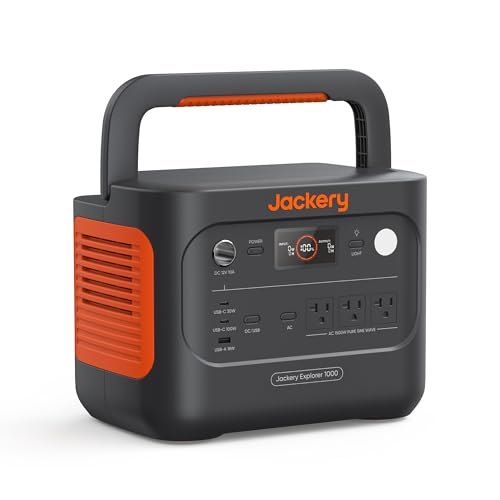
Jackery Explorer 1000 v2
The short answer
This is a 1,070Wh battery with 1,500W of output, which means it stores about 910 watt-hours you can actually use and can run anything drawing up to 1,500 watts at once.
It runs indoors and makes no fumes. Of the 15 household loads we track, it can handle 13. It would keep a refrigerator going for 1.3–9.1 hours.
Check you have the right model
Jackery sells other models that can be mistaken for this one:
- Jackery Explorer 2000 v2 — they differ by a single word: 2000 against 1000. peak output 4,400W instead of 3,000W.
- Jackery Explorer 300 v2 — they differ by a single word: 1000 against 300. peak output 600W instead of 3,000W.
- Jackery Explorer 1500 v2 — they differ by a single word: 1000 against 1500. a different model in the same range.
- Jackery HomePower 1000 v2 — they differ by a single word: EXPLORER against HOMEPOWER. a different model in the same range.
- Jackery Explorer 600 v2 — they differ by a single word: 1000 against 600. a different model in the same range.
Read the full model name off the label on the unit itself, not off the box or the listing. The figures on this page apply only to the exact name in the heading above.
Specs from the maker, checked against 9,944 US safety recalls. Anything we could not confirm is marked.
Judged in: The best portable power stations for camping; Portable power for a CPAP machine: one night, and three; The one-kilowatt-hour class: Jackery 1000 v2, Anker C1000, EcoFlow DELTA 3; Jackery Explorer 1000 v2 vs 1000 Plus: the expandable one or the cheaper one; Jackery Explorer 1000 v2 vs Anker SOLIX C1000 Gen 2; The best portable power stations for camping with a fridge.
What it can run
| Load | Draw | Runtime | Verdict |
|---|---|---|---|
| Wi-Fi router and modem | 15–40W | 22.7–60.6h | Might work |
| Phone charging and small USB devices | 10–40W | 22.7–91.0h | Will work |
| A few LED lights | 15–80W | 11.4–60.6h | Will work |
| Laptop and monitor | 45–150W | 6.1–20.2h | Might work |
| CPAP | 30–100W | 9.1–30.3h | Will work |
| Refrigerator/freezer | 100–700W | 1.3–9.1h | Might work |
| Chest freezer | 80–500W | 1.8–11.4h | Might work |
| Sump pump | 700–1,500W | 0.6–1.3h | Might work |
| Microwave | 800–1,800W | 0.5–1.1h | Might work |
| Coffee maker | 700–1,500W | 0.6–1.3h | Might work |
| Television | 40–250W | 3.6–22.7h | Might work |
| Garage door opener | 300–800W | 1.1–3.0h | Will work |
| 12 V compressor fridge (camping) | 25–110W | 8.3–36.4h | Might work |
The two numbers are how long it lasts if your appliances are efficient, and if they are not. Sized over a 24-hour outage.
Living with it
What the maker’s own pages and manual say about owning this unit, and what owners report in public. Each line links to where it was read. Nothing here is our own test.
- Idle draw
- ≈18W standby/idle power draw while the unit is powered on with no active load, per Jackery's official FAQ spec table (adjacent cell states '18W')faq.jackery.com
- Switchover when the grid drops
- Under 20 ms (0.02s) automatic switchover to battery power on grid loss; maker explicitly states this is not a 0ms/no-break UPS and advises against use with data servers or workstationsfaq.jackery.com
- Pass-through charging
- Supported — the unit can power connected devices while simultaneously recharging (pass-through/bypass charging); maker states this does not affect battery lifespan. The product-page tech-spec table separately rates "Bypass Mode AC Input/Output" at 100-120V~60Hz, 1500Wfaq.jackery.com
- Wall recharge
- Marketing copy claims 0-100% AC recharge in ~1 hour via "Emergency Super Charge" mode; the same product page's tech-spec table separately lists "AC Adapter: 1.58 Hours" for standard-mode AC recharge, and the FAQ spec table states "Around 1.7H" for the same figure — Jackery's own sources disagree on the non-emergency AC recharge time (≈1.6-1.7h ballpark). Independent hands-on reviews measured 1h02m and 1h35m respectivelyjackery.com
- AC input
- 100–120V AC ~60Hz, max 15A, max input power 1000W ± 50W via AC wall charging; FAQ separately states 1100W minimum input power is required to charge this unit from another Jackery power station's AC outputfaq.jackery.com
- USB-C
- 100W max on the primary USB-C port (5V⎓3A, 9V⎓3A, 12V⎓3A, 15V⎓3A, 20V⎓5A); the second USB-C port maxes at 30Wjackery.com
- Outlets and ports
- AC: (3x) 120V~60Hz outlets, 1500W rated / 3000W surge total; USB-C: 1x 100W max (5/9/12/15/20V), 1x 30W max; USB-A: 1x 18W max; Car port: 12V⎓10A max; DC input: (2x) 8mm ports (12-16V⎓8A or 16-60V⎓10.5A/21A dual); AC input: 100-120V~60Hz 15A max; Bypass mode AC in/out: 100-120V~60Hz, 1500Wjackery.com
- Noise
- ≤22dB cooling-fan noise per Jackery's official FAQ spec table; independent hands-on testing found it audibly louder (~55dB) once output climbs above 1000W, while a separate reviewer described it as "fairly quiet" versus louder competitorsfaq.jackery.com
- Charges between
- 0°C to 45°C (32°F to 113°F) for chargingjackery.com
- Runs between
- -10°C to 45°C (14°F to 113°F) for dischargingjackery.com
- Cycle life
- 4,000 charge cycles to reach 70%+ remaining capacity (LiFePO4 cells)jackery.com
- Low-load shutoff
- Energy Saving Mode is on by default and auto-shuts-off all outputs after 12 hours when AC load is ≤25W or USB/Car load is ≤2W (manual's Energy Saving Mode table); separately, the whole unit's default standby time is 2 hours (auto shutdown with no charging/discharging activity at all), adjustable via the Jackery App; Energy Saving Mode itself can be toggled off with a button combor.jackery.net
- App
- Supports the Jackery App (Bluetooth + Wi-Fi, iOS/Android) for remote monitoring and control; the FAQ Q&A list separately confirms the app can toggle AC/DC output, LED display/light, auto-shutdown timer, Energy Saving/Battery Saving/Quiet Charging modes, and device sharing via QR coder.jackery.net
- Expansion
- Not supported — the Explorer 1000 v2 has no add-on/expansion battery pack option (per Jackery's FAQ), unlike some rival power stations in this capacity classfaq.jackery.com
- Size
- 12.87 × 8.82 × 9.72 in (32.7 × 22.4 × 24.7 cm)jackery.com
- Weight
- ≈23.8 lb (10.8 kg)jackery.com
- Warranty
- 3-year standard warranty, extendable by 2 free years for a 5-year total (Jackery.com purchases only); the product page also markets this as "3+2 Years" and separately offers "3-Year Warranty + 2 Extra Years Free" as a purchase-page promofaq.jackery.com
What owners report, from public threads and long-term reviews; not our own testing.
- In hands-on load testing, the unit ran an electric kettle, a 1000W microwave, and a heavy-duty blender at once without tripping overload protection, suggesting the inverter's surge headroom holds up under real kitchen-appliance loads.powerstationlab.com
- One reviewer measured real-world AC recharge at about 1 hour 35 minutes in standard mode (slower than the marketed ~1-hour figure), dropping to just under an hour only when Emergency Charging Mode was manually enabled — a mode the reviewer cautioned could shorten battery longevity if used habitually.thesolarlab.com
- A separate hands-on test clocked wall-charger recharge at 1 hour 2 minutes (matching Jackery's advertised fast-charge claim), while dual 200W solar panels took roughly 3 to 4 hours depending on conditions — independent testers do not agree on how fast the standard AC recharge actually is, so buyers shouldn't bank on a single number.backuppowerhub.com
- At sustained loads near capacity (~1,479W), one reviewer measured about 87.5% efficiency, and the unit tolerated brief surges above its 1,500W rating — over 1,560W for roughly 10 minutes, and a 2,200W spike — before its overload protection cut power, which the reviewer called reassuring headroom for spiky loads like power tools.thesolarlab.com
- Reviewers disagree on real-world fan noise: one called it "fairly quiet" compared to louder competitors, while another measured it becoming clearly audible (around 55dB) and the case getting noticeably warm (about 104°F) once output climbed past 1000W or during fast/Emergency Charging Mode.backuppowerhub.com
- One review found Jackery's own marketing overstates solar input capacity — the site advertises up to 600W of solar input across six panels, but the unit's actual maximum DC input is 400W, unchanged from the prior generation, which could lead buyers to purchase more solar panels than the unit can actually use.thesolarlab.com
- Under heavy pass-through loads (charging while powering a ~1,400W device), input charging power drops significantly, slowing the recharge; only light loads around 100W allowed the input to stay near full rate.thesolarlab.com
- One reviewer reported the unit did not automatically switch over to battery backup during a power-outage test and required manually reconnecting devices — apparently at odds with Jackery's advertised 20ms UPS switchover spec; this may be setup- or firmware-specific rather than a universal defect, so treat as a single data point pending corroboration.backuppowerhub.com
- A reviewer's initial published USB-C port wattage figures were incorrect and had to be corrected after reader feedback and manufacturer clarification, illustrating that even hands-on reviewers have gotten this unit's port specs wrong — a reason to cross-check port wattage against the maker's own spec table rather than any single review.backuppowerhub.com
What independent testers measured
We do not test units ourselves. These are figures published by testers who did, with the maker’s claim beside them where the tester gave it.
| Measurement | Result | Tester |
|---|---|---|
| Usable capacity, measured | 910 Wh measured output (vs 1,070 Wh advertised) (maker: 1,070 Wh) | OutdoorGearLab |
| Also measured | 85% capacity efficiency, calculated by OGL from their measured 910Wh output vs the 1,070Wh advertised rating (not an inverter/AC conversion efficiency spec) | OutdoorGearLab |
| Wall charge, empty to full | Measured charging rate of 563 Wh/hr; took almost 2 hours for a full recharge (charging method/AC vs other not specified in text) | OutdoorGearLab |
| Weight, measured | 24.4 lbs (listed as "Measured Weight" in OGL's spec table) | OutdoorGearLab |
| Noise under load, measured | No dB figure given; qualitative observation only - fans stayed nearly silent even near max wattage | OutdoorGearLab |
- OGL scored it 67/100 (#7 of 14 in their power station category), calling it a decent, user-friendly option for camping/emergency backup for brand-loyal Jackery buyers, but says slower charging and a limited feature set make it less compelling in the crowded 1,000Wh class. OutdoorGearLab
- Concludes the Anker Solix C1000 (Gen 2) wins on outright performance, but says the Jackery Explorer 1000 v2 is a dependable, rugged choice for buyers who value its lighter weight (23.8 lbs) and slightly higher base capacity (1070Wh); NOTE: page shows no first-person testing language (no "we measured/tested") - appears to be a spec-sheet comparison, not hands-on lab testing. PowerStationLab
- Recommends the Jackery Explorer 1000 v2 for buyers who prioritize weight, quiet operation, and solar charging capacity; NOTE: page shows no first-person testing language and no author-measured figures - it references "independent testing" done by others rather than reporting its own hands-on results. TopSolarGear
Specifications
- Capacity
- 1,070Wh nameplate · 910Wh assumed usable
- Continuous output
- 1,500W
- Surge output
- 3,000W
- Output voltage
- 120V
- Weight
- 10.8kg
- Solar input
- 400W
· DC8020 connector
Single port 10.5A/200W; dual parallel ports 21A/400W. - AC recharge
- Jackery's product URL for this model did not resolve during capture; the FAQ surface returns HTTP 403 to automated retrieval. Requires manual capture.
- Expansion battery
- Support article states battery packs are not supported.
- Warranty
- Officially documented
- Generator recharge
- Not captured from official page
Support: Jackery support page
Recall screen
No published recall names this exact model
Zero Jackery recalls in the captured snapshot. Note the automated keyword screen produced 565 low-value candidates purely from the bare token '1000'; none is a Jackery product.
This check cannot clear your own unit. Most recalls cover only certain serial numbers. Read the model and serial number off the label on the unit itself, then check the maker's recall page before you use it, sell it, or buy it.
No manufacturer recall-lookup URL is captured for this brand. Use the CPSC recall search.
How we know the screen was not simply blind
Finding nothing only means something if the search could have found something. So we searched the same records for this brand and got 0 recalls. This brand does not appear in the database at all, so a null result here carries less weight than it would for a brand that does.
Buying the right one
Verified listing — the bare unit
Jackery Explorer 1000 v2 Portable Power Station,1070Wh,1500W
ASIN B0D7PPG25F · $559.00 when checked on 2026-08-13 · purchasable
Title states 1070Wh and 1500W, matching our record exactly. A price is not a product attribute: treat this as the figure at capture time, not today's price.
Some links on this page are affiliate links. If you buy through one we may earn a commission, at no extra cost to you. It does not affect which products the planner recommends: rankings come from the sizing rules on our methodology page, and a product with unresolved safety identity is never ranked or linked regardless of commission.
Listings we rejected
Searching for this model returns bundles, sibling models and refurbished units alongside the bare product. These are the ones we checked and did not link, with the reason.
| Listing | Price | Why it is not this product |
|---|---|---|
| Jackery Explorer 1000 v2 and Extension Cable,1070Wh,1500W AC | $499 | Listing is a bundle (solar panel or kit), not the bare base unit our specifications describe. |
| Jackery Generator 1000 v2 with 200W Panel, 1070Wh Portable Power Station | $699 | Listing is a bundle (solar panel or kit), not the bare base unit our specifications describe. |
| Jackery Explorer 1000 v2 Portable Power Station,1070Wh,1500W (Dune White) | $589 | A stronger exact match was already accepted for this model. |
| Jackery Solar Generator 1000 v2 and 200W Solar Panel,1070Wh,1500W AC | $879 | Listing is a bundle (solar panel or kit), not the bare base unit our specifications describe. |
| Jackery Solar Generator 1000 v2 and 100W Solar Panel,1070Wh,1500W AC | $749 | Listing is a bundle (solar panel or kit), not the bare base unit our specifications describe. |
Official accessories
These are the maker's own words. "Sold on the same page" is not the same claim as "works with this model".
- Extreme Guard Carrying Bag
Manufacturer wording: Compatible with 2000 v2/1000 v2 - Carrying Case (Middle Size)
Manufacturer wording: Compatible with 1000 v2/1000 Plus/2000 v2
Evidence coverage
What we know about this model, and what we do not. Anything marked as needing confirmation is a job still on our list, not something we are claiming.
- manual revision
- captured
- quick start
- captured
- solar connector
- captured
- solar voltage current watt limits
- captured
- ac charge input
- needs confirmation
- generator charge policy
- needs confirmation
- expansion battery family and limit
- captured
- app firmware path
- captured
- warranty
- captured
- support
- captured
- recall adjudication
- captured
- official accessory edges
- captured