The home-backup class: DELTA Pro 3, SOLIX F3800, Explorer 5000 Plus and the rest
The biggest boxes you can buy without calling an electrician, judged against a refrigerator, Wi-Fi, a few LED lights and phone charging for 24 hours. Of the 58 stations we track, 29 cover that day on the best case and none covers it on the worst, these three included.
Buy the Anker SOLIX F3800. It pairs a verified listing at $2,200 with the higher continuous and surge rating of the two picks that have one, and the longest documented expansion path here; take the EcoFlow DELTA Pro 3 if you would rather start with more nominal capacity in the box itself, and the Jackery Explorer 5000 Plus if you want the most battery and the most output on this table and will go and find the price yourself. Every verdict here reads Clears the best case only, not clears the numbers: none of the 58 units we track gets through the worst case of this plan on one charge, and stretching the outage to three days (72 hours) of the same loads does not change that. If the load you are really buying for is wired into the house, a well pump, a furnace blower, central air, then none of this class is the answer, and a 240-volt socket on the front of a battery does not make it one: that is an inlet or transfer switch fitted by a licensed electrician, or a generator standing outside.
The Amazon links on this page are affiliate links: if you buy through one we may earn a commission, at no extra cost to you. It does not change which units are picked. How that works.
| Model | Usable | Output | Short of worst case | Weight | Price | |
|---|---|---|---|---|---|---|
| Our pick | Anker SOLIX F3800 | 3,264 Wh | 6,000 W | 7,152 Wh | 132 lb | on Amazon |
| More battery in the box | EcoFlow DELTA Pro 3 | 3,482 Wh | 4,000 W | 6,934 Wh | 114 lb | on Amazon |
| Most battery, no price | Jackery Explorer 5000 Plus | 4,284 Wh | 7,200 W | 6,132 Wh | 134 lb | no verified listing |
Who this is for
You want a refrigerator, the router, a few lamps and everyone's phones to survive a refrigerator, Wi-Fi, a few LED lights and phone charging for 24 hours, indoors, with nothing to start and no fuel to store, and you have already decided the answer is one of the large boxes rather than something you carry in one hand. Everything on this page is wheeled, waist-high furniture. Decide which room it lives in before you order it.
Leave if the thing you are worried about is wired in. Reviewers emptied the Anker SOLIX F3800 in well under two hours on a central air conditioner, and the EcoFlow DELTA Pro 3's overload protection still tripped on a large air conditioner with a soft-start kit fitted. Neither is a fault; it is the size of the class. Leave too if your plan is smaller than this one, because our home-backup page ranks the units you can still lift.
Side by side, from the makers’ own documents
“Not captured” means the maker’s page we captured does not state it: a gap in our record, not a zero, and never filled from a sibling model. 1 of these are marked (maker page only): we have the headline figures and have not yet researched the rest. “No verified listing” means no Amazon listing for the bare unit passed our identity check yet.
| Model | Battery | Continuous output | Peak output | Weight | Solar input | Expandable | Warranty | Chemistry | Output | Verified listing |
|---|---|---|---|---|---|---|---|---|---|---|
| EcoFlow DELTA Pro 3 | 4,096 Wh | 4,000 W | 8,000 W | 114 lb / 51.5 kg | 2,600 W | yes: DELTA Pro 3 Smart Extra Battery (4096Wh) | 5 years | LiFePO4 | 120V/240V | $3,699 |
| Anker SOLIX F3800 | 3,840 Wh | 6,000 W | 9,000 W | 132 lb / 60.0 kg | 2,400 W | yes: Anker SOLIX BP3800 Expansion Battery | 5 years | LiFePO4 | 120V/240V | $2,200 |
| Anker SOLIX F3800 Plus | 3,840 Wh | 6,000 W | 9,000 W | 132 lb / 60.0 kg | 1,600 W | not captured | not captured | LiFePO4 | 120V/240V | no verified listing |
| Jackery Explorer 5000 Plus | 5,040 Wh | 7,200 W | 14,400 W | 134 lb / 61.0 kg | 1,200 W | documented by the maker (accessory not named on the page we captured) | not captured | LiFePO4 | 120V/240V | no verified listing |
| Jackery HomePower 3600 Plus (maker page only) | 3,600 Wh | 3,600 W | not captured | not captured | not captured | not captured | not captured | not stated in the recoverable content | 120V | no verified listing |
| Goal Zero Yeti PRO 4000 | 3,994 Wh | 3,600 W | 7,200 W | 116 lb / 52.5 kg | 3,000 W | not captured | not captured | LiFePO4 | 120V | no verified listing |
| EcoFlow DELTA Pro | 3,600 Wh | 3,600 W | 7,200 W | 99 lb / 45.0 kg | 1,600 W | not captured | not captured | LiFePO4 | 120V | no verified listing |
Against the same plan
A refrigerator, Wi-Fi, a few LED lights and phone charging for 24 hours, sized on the harder end of every range.
The refrigerator is almost the whole number. Wi-Fi, lights and phone charging together barely register; the compressor is most of the energy and all of the starting surge. A new fridge in a cool kitchen with the door mostly shut runs about a fifth of the time and needs 918 watt-hours across the day; an older one in a warm kitchen, opened often, runs half the time and needs 10,416. All three start it easily, even at the top of the 3,060 watt surge.
The worst case is out of reach for every battery here, and it is not close. Nominal capacity is not what comes out of the sockets: each usable figure sits below the number on the box, and one independent measurement put the Anker SOLIX F3800's real inverter losses at around fifteen percent of what you draw. The gap from the largest battery here to the smallest is narrower than the gap between a single fridge's own best and worst case, which is why 29 of the 58 units we track clear the best case and not one clears the worst.
So the choice is not capacity. It is 240-volt output, which these three and Anker's SOLIX F3800 Plus list and the rest of this class does not; the expansion path, where the Anker SOLIX F3800 documents the most packs and the EcoFlow DELTA Pro 3 the fewest; inputs, because refill speed decides day two; weight, where all three are a two-person job; and paperwork, because two of the three have a verified listing and one has none.
| Model | Covers the energy | Carries the running load | Clears the surge | Worst-case shortfall | Verdict |
|---|---|---|---|---|---|
| EcoFlow DELTA Pro 3 | best case only | worst case | worst case | 6,934 Wh | Clears the best case only |
| Anker SOLIX F3800 | best case only | worst case | worst case | 7,152 Wh | Clears the best case only |
| Anker SOLIX F3800 Plus | best case only | worst case | worst case | 7,152 Wh | Clears the best case only |
| Jackery Explorer 5000 Plus | best case only | worst case | worst case | 6,132 Wh | Clears the best case only |
| Jackery HomePower 3600 Plus | best case only | worst case | not published | 7,356 Wh | Clears the best case only |
| Goal Zero Yeti PRO 4000 | best case only | worst case | worst case | 7,021 Wh | Clears the best case only |
| EcoFlow DELTA Pro | best case only | worst case | worst case | 7,356 Wh | Clears the best case only |
Where the energy goes, load by load
| Load | Hours | Running watts | Duty cycle | Energy | Share of worst case |
|---|---|---|---|---|---|
| Refrigerator/freezer | 24 | 100–700 | 20–50% | 480–8,400 Wh | 81% |
| Wi-Fi router and modem | 24 | 15–40 | 100% | 360–960 Wh | 9% |
| Phone charging and small USB devices | 24 | 10–40 | 20–60% | 48–576 Wh | 6% |
| A few LED lights | 8 | 15–80 | 25–75% | 30–480 Wh | 5% |
Energy = running watts × duty cycle × hours, at each end of the range. The right-hand end of every row is what the plan is sized on.
Our pickAnker SOLIX F3800
The one most people should buy
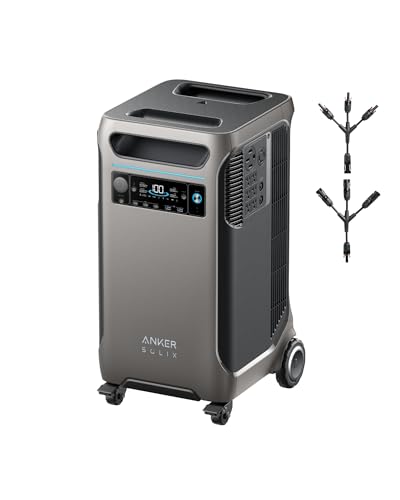
$2,200 at Amazon, September 16, 20263,840 Wh (3,264 usable)6,000 W continuous9,000 W peak132 lb
The Anker SOLIX F3800 is the one with the fewest open questions. It has a verified listing at $2,200, the higher continuous and surge rating over the EcoFlow DELTA Pro 3, and the longest expansion path any of the three documents, up to six of Anker's own packs. It gives up nominal capacity to the other two, and its verdict is still Clears the best case only. It suits the person who wants output headroom and a confirmed price, and who would rather buy more battery later than pay for it now.
Against the worst case it is 7,152 Wh short: about 3.0 hours of full sun at its 2,400 W solar input, or roughly 36 hours from one 200 W panel, and real panels deliver less than their rating.
The listing we verified as the bare unit; the price is on Amazon.
A refrigerator, Wi-Fi, a few LED lights and phone charging for 24 hours:
- Energyonly in the best case
- Running loadyes, even in the worst case
- Starting surgeyes, even in the worst case
Living with it
It arrives on casters with a telescoping handle, and every hands-on reviewer says the same thing about it: the wheels roll it into position, they do not move it. One team carrying it upstairs and loading it into a vehicle during a post-hurricane outage needed a second pair of hands for both. Pick the room first.
Anker publishes no wall-recharge time, no pass-through figure and no idle draw for this unit on anything we captured, and we will not borrow the pass-through claim printed alongside it, because that one belongs to a different, smaller product card on the same page. What we have instead is measurement: a three-week test recharged it from empty to most of full from a wall socket in well under two hours, and one reviewer ran a fridge on it for a full day after a hurricane and found the app steady over Bluetooth for checking the level and setting charge times. It will not charge below freezing and it runs a good way below that, a wider cold range than the other two.
At light loads the fans cycle on and off unpredictably rather than settling, and one tester found it nearly silent under a heavy kitchen load; another measured them engaging once draw passes roughly two fifths of the rating and climbing sharply near the top, which is louder than its quiet reputation suggests. The built-in light is a nightlight, not work lighting. Five-year warranty. One oddity worth knowing: an embedded data block on Anker's own page labels the 120-volt sockets as a 250-volt outlet type while the visible spec box on the same page names the ordinary 120-volt one, which reads as a data-entry error rather than a specification.
- Charges between
- 0°C to 40°C (32°F to 104°F) while chargingsignaturesolar.com
- Low-load shutoff
- Shuts off after about 12 h idle with no loadsignaturesolar.com
- Expansion
- Up to 6 add-on batteries, 26.88 kWh added capacityankersolix.com
What owners report, from public threads and long-term reviews; not our own testing.
- Multiple reviewers report fan noise climbs sharply under heavy load — about 68 dB at 90% load versus 58 dB at 50% load — despite near-silent operation at lighter loads.backuppowerhub.com
- The roughly 132 lb weight is a recurring complaint; reviewers needed a second person or a vehicle ramp to move it anywhere the built-in wheels couldn't roll it.protoolreviews.com
- One long-term tester measured real-world AC recharge at about 1 hour 38 minutes to 80% (roughly 2h21m full) on a standard outlet, slower than a quick top-up.backuppowerhub.com
- A 2-ton central air conditioner drained the unit in only about 1.6 hours despite its 6,000W rating, so it isn't a practical all-day whole-home AC backup alone.backuppowerhub.com
- One tester measured real-world inverter efficiency at only about 85%, meaning a 3,000W draw actually consumes roughly 3,530Wh from the battery — more than the rated draw implies.backuppowerhub.com
What independent testers measured
We do not test units ourselves. These are figures published by testers who did, with the maker’s claim beside them where the tester gave it.
| Measurement | Result | Tester |
|---|---|---|
| Wall charge, to 80% | 1 hour 38 minutes from 0-80% on a standard 120V/15A outlet (max 1,440W input) | Backup Power Hub |
| Wall charge, empty to full | 2 hours 21 minutes from dead to full via AC | Backup Power Hub |
| Inverter efficiency, measured | ~85% inverter efficiency, measured during testing | Backup Power Hub |
| Solar input achieved | 1,850W peak solar input achieved with three 400W panels in ideal conditions (maker: 2,400W rated solar input (per generatorchecker.com spec listing, not stated by this tester)) | Backup Power Hub |
| Noise under load, measured | 58 dB at 3 feet at 50% load (3000W) | Backup Power Hub |
| Noise under load, measured | 68 dB at 90% load (5400W), 'comparable to a dishwasher' | Backup Power Hub |
- After a three-week real-world test running central AC, refrigerators, and power tools, the reviewer rated the F3800 9.2/10, calling it the best split-phase 240V whole-home option currently on the market. (Editor's Choice (per site homepage listing, 9.2/10)) Backup Power Hub
- The reviewer calls the F3800 a solid investment at $3,499 for whole-home backup power or off-grid adventures, despite it being the heaviest single-unit station they've tested. The Solar Lab
What you give up
Capacity. It holds the least of the three, and the other two are what you buy if that is the number you care about. There is also a naming trap: Anker's SOLIX F3800 Plus shares the maker page and matches this unit across our whole record apart from solar input, we cannot separate the two from what we captured, and the verified listing described here is for the base F3800. Match the model number on the box before you pay.
Figures from ankersolix.com, captured August 12, 2026; recall screen: no published recall names this exact model (screened 2026-08-12) (how we screen, CPSC).
More battery in the boxEcoFlow DELTA Pro 3
More capacity, close second
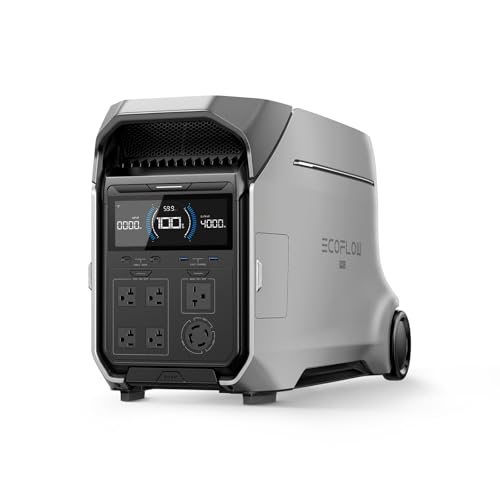
$3,699 at Amazon, September 16, 20264,096 Wh (3,482 usable)4,000 W continuous8,000 W peak114 lb
The EcoFlow DELTA Pro 3 carries somewhat more nominal capacity than the Anker SOLIX F3800, names its own extra battery and has a verified listing of its own, which makes it the straightforward answer if you want the bigger single box from a maker whose accessory you can actually order. It gives up continuous and surge headroom to both the others, and it costs more per watt-hour of battery than the Anker SOLIX F3800. It suits someone buying one unit, registering it, and leaving it where it stands.
Against the worst case it is 6,934 Wh short: about 2.7 hours of full sun at its 2,600 W solar input, or roughly 35 hours from one 200 W panel, and real panels deliver less than their rating.
The listing we verified as the bare unit; the price is on Amazon.
A refrigerator, Wi-Fi, a few LED lights and phone charging for 24 hours:
- Energyonly in the best case
- Running loadyes, even in the worst case
- Starting surgeyes, even in the worst case
Living with it
Reviewers call it movable rather than portable, with a telescoping handle they describe as wobbly, and recommend a ramp or a second person to get it into a car. It cannot put out 120 and 240 volts at the same time, which matters if you were counting on both. Its extra-battery port takes up to two packs and is backwards compatible with the older DELTA Pro battery.
Two headline claims do not survive the manual. EcoFlow advertises full continuous output while the unit is plugged in and charging, but the manual's own bypass row caps the US path at roughly what a wall socket delivers, for a few hours and less after that, and a tester found an air-conditioner start surge tripped a shutdown in bypass on a unit that handles far more running off its battery. The wall-recharge headline, most of a charge inside an hour, reflects a combined multi-input charge rather than a plain outlet; the manual's own AC input socket is far slower, and testers measured close to three hours, with the time-remaining readout wrong for a long stretch near the end.
The switchover is advertised in hundredths of a second, but one tester reported a floating ground on transfer that clicked a desktop PC's power supply off, and suggests a small UPS between sensitive electronics and the station. It is quiet enough at ordinary loads that owners ran it beside CPAP machines overnight, and becomes a high-pitched whine near the top. One long-term tester hit repeated false short-circuit shutdowns for about five weeks, each needing a manual reset, until a firmware update cleared them. The warranty is three years, five if you register the unit in the app, so register it. EcoFlow publishes no idle draw anywhere we could find, and the figure circulating online has no source behind it, so treat it as an open question.
- Switchover when the grid drops
- 10 ms rated; can still trip sensitive electronics per testersecoflow.ie
- Pass-through charging
- Up to 4,000W claimed, but bypass mode capped near 1,800Wus.ecoflow.com
- Wall recharge
- 80% in 50 min claimed; testers measured closer to 3 hoursus.ecoflow.com
- Noise
- As low as 30 dB claimed; whine noticeable at higher loadsecoflow.com
- Charges between
- 0°C to 45°C (32°F to 113°F)ecoflow.ie
- Low-load shutoff
- AC output auto-shuts off after idle; adjustable, can disableecoflow.ie
- Expansion
- Up to 2 extra batteries via one expansion portecoflow.ie
- Warranty
- 3-year warranty, extendable to 5 years by registeringus.ecoflow.com
What owners report, from public threads and long-term reviews; not our own testing.
- One long-term tester experienced repeated false 'electrical short' shutdowns over about 5 weeks, each needing a manual reset, until a firmware update appeared to fix it.cleantechnica.com
- A tester found the UPS switchover used a 'floating ground' that caused a desktop PC to click off during a transfer despite the advertised under-10ms switchover time.robbsutton.com
- The marketed 4,000W pass-through capacity is capped near 1,800W in US bypass mode, and one AC compressor's startup surge tripped a shutdown even though the unit handles 4,000W fine on battery alone.cleantechnica.com
- At about 114 lb with a telescoping handle described as wobbly when extended, reviewers call the unit 'movable' rather than truly portable, recommending a ramp or a second person to load it.robbsutton.com
- Despite the 4,000W rating, a 3-ton central AC unit fitted with a soft-start kit still triggered overload protection in one test, raising doubts about its use for whole-home HVAC backup.robbsutton.com
What independent testers measured
We do not test units ourselves. These are figures published by testers who did, with the maker’s claim beside them where the tester gave it.
| Measurement | Result | Tester |
|---|---|---|
| Inverter efficiency, measured | About 89% efficiency sustaining a near-maximum (~3,650W) load for 60 minutes | The Solar Lab |
| Wall charge, empty to full | About 2 hours 54 minutes (174 min) full AC charge, tester-measured (maker: 2 hours 20 minutes (140 min) advertised) | The Solar Lab |
| Also measured | Surge test: handled 5,100W for nearly a minute before shutting down as load approached 6,000W | The Solar Lab |
| Also measured | Qualitative noise: quiet under a 2,000W load, more noticeable at higher loads (no dB figure given) | The Solar Lab |
| Also measured | Pass-through charging tested and worked correctly | The Solar Lab |
| Weight, measured | 113 lb, noted by the tester as heavier than the original DELTA Pro | The Solar Lab |
- Scored 81/100, ranked #2 of 14 power stations tested, and named Best for Home Backup for its power output and expansion capability despite its weight and price. (Best for Home Backup) OutdoorGearLab
- A solid, worthy power station overall, but an incremental update that existing DELTA Pro owners have little compelling reason to upgrade to. The Solar Lab
What you give up
Output headroom and money. It has the lowest continuous and surge rating of the three, it is the more expensive per watt-hour of battery of the two picks with listings, and its pass-through ceiling is well under its headline output. The Anker SOLIX F3800 sits beside it with a verified listing, more output and more expansion; the extra nominal capacity here is the only thing that argues back.
Figures from us.ecoflow.com, captured August 12, 2026; recall screen: no published recall names this exact model (screened 2026-08-12) (how we screen, CPSC).
Most battery, no priceJackery Explorer 5000 Plus
Most battery in one box
5,040 Wh (4,284 usable)7,200 W continuous14,400 W peak134 lb
The Jackery Explorer 5000 Plus holds the most nominal capacity and posts the highest continuous and surge ratings on this table, and it has the most convincing owner evidence of the three under real household loads, including a well pump starting cleanly across dozens of test cycles. What it gives up is certainty: there is no verified listing for this exact unit, so we quote no price, and every close match we found was a bundle. It suits someone happy to do the model-number and price checking themselves.
Against the worst case it is 6,132 Wh short: about 5.1 hours of full sun at its 1,200 W solar input, or roughly 31 hours from one 200 W panel, and real panels deliver less than their rating.
No Amazon listing for the bare unit has passed our identity check, so no price and no Amazon link.
A refrigerator, Wi-Fi, a few LED lights and phone charging for 24 hours:
- Energyonly in the best case
- Running loadyes, even in the worst case
- Starting surgeyes, even in the worst case
Living with it
It is the heaviest of the three, and the expansion story is documented but incomplete: the manual names a battery pack and allows several of them through dedicated ports, with a required gap between the unit and the pack, but it does not say what one pack holds, so the expanded total is not confirmed here, and the maker page we captured does not name the accessory at all.
The switchover is the interesting part. In its default backup mode it transfers in hundredths of a second; there is a true gapless mode as well, but it works only on two of the sockets and halves the output rating, so the uninterrupted option is the small one. A reviewer running a ninety-day test measured the default transfer in under two thousandths of a second with computers and medical equipment connected and saw nothing drop. The same test recharged it from empty to full from a wall socket in well under two hours, close to Jackery's own claim, and measured a real idle draw, enough to flatten the unit in a few days doing nothing, which was still better than the rival it was compared against. Its energy-saving mode is on by default and switches every output off after half a day if the load stays under a low threshold; a fridge spends much of the day drawing nothing, so turn that off in the app before an outage rather than after.
Noise is modest until you are into the upper half of the rating, then clearly audible. The app uses Wi-Fi on the slower band only, and reviewers had to force-close and reopen it during long runs. There is no battery heater, so it will not charge below freezing, and output is capped in the coldest part of its running range. The RV socket looks like the large one but is wired for the smaller service. The solar door does not fold flat, so you kneel to reach the connectors. The manual and one review site quote the same cycle count against different remaining-capacity figures; we take the manual's. Five-year warranty, extendable for a fee.
- Switchover when the grid drops
- Under 20 ms normally; 0 ms in Online UPS mode on 2 outlets onlyr.jackery.net
- Pass-through charging
- Can power devices while charging; 2 outlets excluded from bypassr.jackery.net
- Charges between
- 0°C to 45°C (32°F to 113°F) for chargingr.jackery.net
- Low-load shutoff
- Outputs auto-shut off after 12h with no load; adjustable in appr.jackery.net
- Expansion
- Expandable with up to 5 extra battery packsr.jackery.net
- Warranty
- 5-year standard warranty; 2-year extension available for a feer.jackery.net
What owners report, from public threads and long-term reviews; not our own testing.
- One 90-day reviewer measured idle draw at about 58W, meaning the unit could sit unused for roughly 3.5 days before fully discharging, better than a rival's ~80W idle draw.thesolarlab.com
- Despite the 14,400W surge rating, one reviewer's unit struggled to start a 10,000W-surge air conditioner, though it handled 8,000 to 9,500W loads for 20 to 30 seconds at a time.thesolarlab.com
- The included 50A-style RV port is only wired for 30A service, limiting its usefulness for RVs or trailers that expect a full 50A feed.thesolarlab.com
- One reviewer measured fan noise at 35-40 dB under lighter loads, rising to 55-60 dB above 5,000W, and said the companion app occasionally freezes and needs restarting.backuppowerhub.com
- The unit has no built-in battery heating and cannot be charged below freezing without external heat, consistent with its 0°C charging floor.backuppowerhub.com
What you give up
The price, which we cannot give you, and the weight, which is the most of the three. One more thing to weigh: despite the highest surge rating here, it could not start one very high-surge air conditioner in testing, though it carried loads near its continuous rating in bursts. Both other picks have a verified listing, and if a confirmed price matters more to you than the largest battery, buy one of those.
Figures from jackery.com, captured August 12, 2026; recall screen: no published recall names this exact model (screened 2026-08-12) (how we screen, CPSC).
Past the first day
Stretch the same loads to three days (72 hours) of the same loads and it goes from tight to hopeless: 2,754 watt-hours at the efficient end, 31,248 at the hard end, against batteries that needed the best case to cover one day. Past the first day the question stops being which box and becomes the refill.
There are three refills and you want two of them. Solar is the one that works while the grid is down, and the ratings are optimistic: one test of the Anker SOLIX F3800 saw three large panels in good sun come close to its claimed input, and cloud drop that to roughly a third, while a reviewer of the EcoFlow DELTA Pro 3 says its combined figure needs two separate arrays on two differently specified ports and suggests planning on about two thirds of it. An extra battery is the other refill, because it works at night. The wall is the third, and it helps only once the power is back, or from a generator outside.
Buying it right
A search for any of these models returns bundles, sibling models and, often, the same unit under two listings at different prices. We link only a listing whose own title states the bare unit and its exact battery and output; the box should say the same. Check the seller is the maker or Amazon itself, and that the model number on the label matches the one on this page.
Anker SOLIX F3800
- The listing we verified: “Anker SOLIX F3800 Portable Power Station, 3,840Wh”, $2,200 when checked. Title states 3840Wh and the exact model name with no variant word; it does not state a wattage, so output was not cross-checked against our 6000W record. (previously verified ASIN, re-checked by direct lookup)
- “Anker SOLIX F3800 Portable Power Station and 400W Solar Panel, 3,840Wh”, $2,400: a bundle, not the bare unit; the extra hardware is in the price.
- “Anker SOLIX F3800 Portable Power Station, 3840Wh, LiFePO4 Batteries, Ultra-High 6000W AC Output with 120V/240V, Solar Generator for Home Backup and Outdoor Camping (Renewed)”, $1,759: Listing is renewed/refurbished, not the new base unit..
EcoFlow DELTA Pro 3
- The listing we verified: “EF ECOFLOW DELTA Pro 3 Portable Power Station, 4096Wh, 4000W AC Output”, $3,699 when checked. Title states 4096Wh and 4000W, matching our record exactly.
- “EF ECOFLOW Power Station 4096Wh DELTA Pro 3 with 400W Portable Solar Panel”, $3,099: a bundle, not the bare unit; the extra hardware is in the price.
- “EF ECOFLOW Portable Power Station 3600Wh DELTA Pro, 120V 3600W AC Output”, $1,899: a different model that a search for this one returns.
- “EF ECOFLOW 12kWh Portable Power Station: DELTA Pro 3 with 2 Extra Batteries”, $6,169: Listing title does not state a capacity, so base-unit identity cannot be confirmed..
Jackery Explorer 5000 Plus
- “Jackery Solar Generator 5000 Plus Portable Power Station, 5040Wh LiFePO4, 7200W 120V/240V AC Output, Expandable to 60kWh, Essential Home Backup for Power Outages (Solar Panel Optional)”, $3,149: a bundle, not the bare unit; the extra hardware is in the price.
- “Jackery HomePower 3600 Plus Power Station, 3584Wh, 3600W AC Output”, $1,709: a different model that a search for this one returns.
What this page can’t promise
Nothing here was tested by us. The specifications are the makers' own, read off their product pages and manuals, and where a marketing page and the manual behind it disagree, which happens more than once in this group, we say so rather than quote the better number. What owners found is labelled as theirs, and there is little of it: no owner forum threads turned up for any of these three, so the reports below come from a handful of hands-on review sites.
It also cannot tell you which end of the range your own fridge sits on, the question that decides everything else, and it cannot price the Jackery Explorer 5000 Plus, because no listing we found matches that exact unit.
Questions people ask
How many days will the Anker SOLIX F3800, EcoFlow DELTA Pro 3 or Jackery Explorer 5000 Plus run my fridge?
In this plan, a refrigerator, Wi-Fi, a few LED lights and phone charging for 24 hours, all three land on the same verdict: each covers the best case and none covers the worst. Stretch it to three days (72 hours) of the same loads and the picture changes in degree, not in kind, because none of the 58 units we track reaches 31,248 watt-hours without a recharge. Plan on solar, an extra battery, or a wall top-up once the grid returns.
What is the difference between the Anker SOLIX F3800 and the EcoFlow DELTA Pro 3?
Both have verified listings, both name their own expansion battery, and both cover the same best case here. The Anker SOLIX F3800 has the higher continuous and surge rating and documents three times as many expansion packs; the EcoFlow DELTA Pro 3 starts with somewhat more nominal capacity and costs more. Warranty does not separate them: our record gives both the same term, though EcoFlow's depends on registering the unit in its app.
Is the Anker SOLIX F3800 Plus the same unit as the F3800?
On paper, close to it. Everything we have on record for the F3800 Plus matches the Anker SOLIX F3800 apart from a lower solar input, and we cannot separate them from the maker page we captured, which sells both. The verified listing described on this page is the base F3800, not the Plus. Check the model number with the retailer before you buy, because the two are not priced alike.
Do any of these put out 240 volts for a well pump?
The Anker SOLIX F3800, the EcoFlow DELTA Pro 3, the Jackery Explorer 5000 Plus and the F3800 Plus all list 120-volt and 240-volt output; the rest of this class lists 120 volts only. But this page sizes plug-in loads. A well pump, or anything else wired into the house, needs a transfer switch or an inlet that a licensed electrician installs, and a socket on the front of the battery does not replace that work.
Why is there no price for the Jackery Explorer 5000 Plus?
Because no listing we found matches this exact unit. Every close candidate turned out to be a bundle, paired with panels or a transfer switch, and a bundle price tells you nothing about what the bare station costs. We would rather show nothing than pin a price to the wrong item. The Anker SOLIX F3800 and the EcoFlow DELTA Pro 3 both have verified, priced listings, which is part of why they come first.
Other plans we sized
- Home backupThe best portable power stations for home backup
A fridge, the internet, a few lamps and everyone's phones through a day without the grid, indoors, with no engine to run. Sized on the harder end of every range.
- Camping and road tripsThe best portable power stations for camping
Two nights of phones, a laptop and a few lights is a small job with a wide range, and the range is what catches people out. All three picks cover the easy end of it on one charge; the hard end takes a panel at the site or a full charge before you leave.
- CPAPPortable power for a CPAP machine: one night, and three
A CPAP is a small, steady load, so this comes down to battery size and one switch: the heated humidifier. Covering a single night is settled; covering three, or running the heat, takes a bigger box.
- Portable generatorsThe best portable generators for home backup
Three generators judged on the one number that decides the job: the watts on tap for the second a fridge and a chest freezer both restart at once. Not battery capacity, and not the running total.
- RefrigeratorHow much battery it takes to run a refrigerator, and which power station does it
A fridge is the appliance everyone wants kept running, and the one whose appetite varies most from house to house. Size it on the harder end of that range and the choice of station mostly makes itself.
- Sump pumpThe best portable power stations for a sump pump
A sump pump is a motor that starts hard and then runs in bursts: the starting surge decides which station can start it at all, and the weather decides how much energy it drinks. Sized on the harder end of every range.
- FurnaceThe best portable power stations for a gas furnace
A gas furnace burns its own fuel and asks the grid only for the blower and the control board, which is the good news. The bad news is that both are wired into the house, so the battery is half the job and an electrician is the other half.
- Well pumpThe best backup power for a well pump
A well pump is the hardest start in an ordinary house, and it is wired in at 240 volts rather than plugged into anything. That is why this plan usually lands on a generator, and why every figure here is sized on the harder end of its range.
- ComparedAnker SOLIX F3800 vs F3800 Plus: the real differences
The Anker SOLIX F3800 and F3800 Plus side by side from Anker's own figures, judged against one full-day household plan, with the real differences marked.
- Camping with a fridgeThe best portable power stations for camping with a fridge
Put a compressor fridge in the back of the car and it becomes most of the battery: it is the one thing in your kit that keeps drawing while you sleep. We size this page from the hard end of every range.
- GuidePower station or generator: which do you actually need?
This is the decision that comes before choosing a product, and it is the expensive one to get wrong in either direction. A battery bought for a well pump is wasted money; a standby generator bought to keep a router alive is a great deal more of it.
- GuideHow to connect a power station to your house
These four methods differ less in how much power they move than in what they can reach: a cord reaches a plug, transfer equipment reaches a circuit. The fifth thing people try, a cord into a wall socket, can kill the line worker restoring your power.
- GuideSolar panels for a power station: how many, and how long
Panels are where the optimism creeps into a backup plan. The arithmetic is simple enough to do on the back of an envelope, and the answer it gives you is the best case, not the likely one.
- GuideExpansion batteries: what an extra battery for a power station actually does
An extra battery for a power station is the cheapest-sounding fix for the wrong problem about half the time. It buys hours, it does not buy watts, and the pack you buy has to be the exact one your station was built for.
Anker SOLIX F3800Our pick
Check price at Amazon