Anker SOLIX F3800 vs F3800 Plus: the real differences
Two power stations that share a name, a product page, a battery and an inverter. What separates them is the way power gets in, and whether there is a listing we can verify.
Buy the Anker SOLIX F3800: it is the one with a verified listing, at $2,200, and it carries the same battery and the same continuous and surge output as the Anker SOLIX F3800 Plus in our record. The Plus is not a trim level of the base unit but a separate machine, with its own model number and its own manual, rebuilt around its inputs. No listing for the bare Plus passed our check, every close match was a bundle, so we quote no price for it and you would be doing that research yourself. Against this plan both land on the same verdict, Clears the best case only.
The Amazon links on this page are affiliate links: if you buy through one we may earn a commission, at no extra cost to you. It does not change which units are picked. How that works.
| Model | Usable | Output | Short of worst case | Weight | Price | |
|---|---|---|---|---|---|---|
| The one you can buy | Anker SOLIX F3800 | 3,264 Wh | 6,000 W | 7,152 Wh | 132 lb | on Amazon |
| The Plus, no price | Anker SOLIX F3800 Plus | 3,264 Wh | 6,000 W | 7,152 Wh | 132 lb | no verified listing |
Who this is for
You have settled on Anker's biggest wheeled box and found two of them on one product page with almost the same name, and you want to know whether the Plus is a newer version of the thing you were about to buy or a different machine. It is a different machine. This page is about what changed and which one to order.
Leave if the brand is still open: our three-way comparison of the big wheeled stations sets this class against EcoFlow and Jackery. Leave as well if the load you are buying for is wired into the house. A two-ton central air conditioner drained this unit in a small fraction of the day you are planning for, and the 240-volt socket on the front is not a transfer switch; that is an electrician's job.
Side by side, from the makers’ own documents
“Not captured” means the maker’s page we captured does not state it: a gap in our record, not a zero, and never filled from a sibling model. “No verified listing” means no Amazon listing for the bare unit passed our identity check yet.
| Model | Battery | Continuous output | Peak output | Weight | Solar input | Expandable | Warranty | Chemistry | Verified listing |
|---|---|---|---|---|---|---|---|---|---|
| Anker SOLIX F3800 | 3,840 Wh | 6,000 W | 9,000 W | 132 lb / 60.0 kg | 2,400 W | yes: Anker SOLIX BP3800 Expansion Battery | 5 years | LiFePO4 | $2,200 |
| Anker SOLIX F3800 Plus | 3,840 Wh | 6,000 W | 9,000 W | 132 lb / 60.0 kg | 1,600 W | not captured | not captured | LiFePO4 | no verified listing |
| EcoFlow DELTA Pro 3 | 4,096 Wh | 4,000 W | 8,000 W | 114 lb / 51.5 kg | 2,600 W | yes: DELTA Pro 3 Smart Extra Battery (4096Wh) | 5 years | LiFePO4 | $3,699 |
Against the same plan
A refrigerator, Wi-Fi, a few LED lights and phone charging for 24 hours, sized on the harder end of every range.
The refrigerator is almost the whole number, and the reason the answer is a range: a newer one in a cool kitchen needs 918 watt-hours across 24 hours, an older one opened all day needs 10,416. Wi-Fi, lights and phones barely register. Capacity does not separate these two: same battery, same output, the same 3,060 watt surge covered, both reading Clears the best case only, both among the 29 of 58 stations that cover the best case while none covers the worst.
The difference is the inputs. The base takes solar on Anker's XT-60 connector; the Plus moves to MC4, so existing Anker panels need adapters despite the page's compatibility claims. The Plus splits solar across two ports with a combined ceiling above the base unit's single rating, and one review outlet reports the base struggled to reach even its rated solar figure while the Plus charges at its rated speed on standard MC4 panels. The same outlet reports the Plus alone falls well short of its headline combined charging rate, which needs two expansion batteries, and flags the TT-30R outlet as rated below the amperage its name implies, enough to leave an RV hookup stuttering.
Anker's product page and the Plus's own manual disagree about what the Plus weighs, by about a pound; we report both. The idle-draw and temperature figures circulating for this pair were labelled for the Plus, not the base, and on a later pass were gone from the maker's page, so we record no idle draw for either.
| Model | Covers the energy | Carries the running load | Clears the surge | Worst-case shortfall | Verdict |
|---|---|---|---|---|---|
| Anker SOLIX F3800 | best case only | worst case | worst case | 7,152 Wh | Clears the best case only |
| Anker SOLIX F3800 Plus | best case only | worst case | worst case | 7,152 Wh | Clears the best case only |
| EcoFlow DELTA Pro 3 | best case only | worst case | worst case | 6,934 Wh | Clears the best case only |
Where the energy goes, load by load
| Load | Hours | Running watts | Duty cycle | Energy | Share of worst case |
|---|---|---|---|---|---|
| Refrigerator/freezer | 24 | 100–700 | 20–50% | 480–8,400 Wh | 81% |
| Wi-Fi router and modem | 24 | 15–40 | 100% | 360–960 Wh | 9% |
| Phone charging and small USB devices | 24 | 10–40 | 20–60% | 48–576 Wh | 6% |
| A few LED lights | 8 | 15–80 | 25–75% | 30–480 Wh | 5% |
Energy = running watts × duty cycle × hours, at each end of the range. The right-hand end of every row is what the plan is sized on.
The one you can buyAnker SOLIX F3800
The one you can buy today
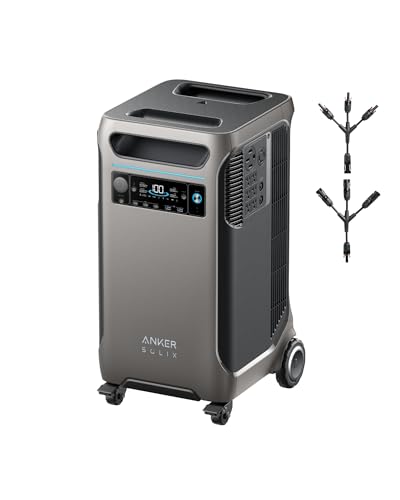
$2,200 at Amazon, September 16, 20263,840 Wh (3,264 usable)6,000 W continuous9,000 W peak132 lb
The Anker SOLIX F3800 is the one with the fewest open questions: a verified listing at $2,200, and the same battery, continuous rating and surge rating our record gives the Anker SOLIX F3800 Plus. It reads Clears the best case only against this plan, exactly as the Plus does, so nothing about the day you are buying for argues for spending more. It suits the person who already owns Anker panels on the older connector, or who has no solar at all and wants the confirmed price.
Against the worst case it is 7,152 Wh short: about 3.0 hours of full sun at its 2,400 W solar input, or roughly 36 hours from one 200 W panel, and real panels deliver less than their rating.
The listing we verified as the bare unit; the price is on Amazon.
A refrigerator, Wi-Fi, a few LED lights and phone charging for 24 hours:
- Energyonly in the best case
- Running loadyes, even in the worst case
- Starting surgeyes, even in the worst case
Living with it
It arrives on casters with a telescoping handle, and every reviewer says the same thing: the wheels roll it into position, they do not relocate it. One team needed a second person to carry it upstairs and to load it into a vehicle during an outage. Choose the room before you order.
Anker publishes no wall-recharge time, no idle draw and no pass-through for this unit on anything we captured. What we have instead is measurement: a three-week test took it from empty to most of a charge on an ordinary outlet in well under an afternoon, and saw three large panels in strong sun push solar input close to its rating, with cloud cutting that to roughly a third. The same test found real inverter efficiency well short of ideal, so the battery gives up more than the sockets deliver. It will not charge below freezing and runs a long way colder.
At light loads the fans cycle on and off unpredictably rather than settling; one tester found it nearly silent under a heavy kitchen load, while another measured them engaging past about two fifths of the rating and climbing sharply near the top. The built-in light is a nightlight, not work lighting. One reviewer ran a refrigerator through a day-long outage after Hurricane Milton and found the app steady over Bluetooth. Five-year warranty. One oddity: a hidden data block on Anker's page gives the 120-volt sockets a 250-volt outlet type while the visible spec box names the ordinary one, a typing error rather than a specification.
- Charges between
- 0°C to 40°C (32°F to 104°F) while chargingsignaturesolar.com
- Low-load shutoff
- Shuts off after about 12 h idle with no loadsignaturesolar.com
- Expansion
- Up to 6 add-on batteries, 26.88 kWh added capacityankersolix.com
What owners report, from public threads and long-term reviews; not our own testing.
- Multiple reviewers report fan noise climbs sharply under heavy load — about 68 dB at 90% load versus 58 dB at 50% load — despite near-silent operation at lighter loads.backuppowerhub.com
- The roughly 132 lb weight is a recurring complaint; reviewers needed a second person or a vehicle ramp to move it anywhere the built-in wheels couldn't roll it.protoolreviews.com
- One long-term tester measured real-world AC recharge at about 1 hour 38 minutes to 80% (roughly 2h21m full) on a standard outlet, slower than a quick top-up.backuppowerhub.com
- A 2-ton central air conditioner drained the unit in only about 1.6 hours despite its 6,000W rating, so it isn't a practical all-day whole-home AC backup alone.backuppowerhub.com
- One tester measured real-world inverter efficiency at only about 85%, meaning a 3,000W draw actually consumes roughly 3,530Wh from the battery — more than the rated draw implies.backuppowerhub.com
What independent testers measured
We do not test units ourselves. These are figures published by testers who did, with the maker’s claim beside them where the tester gave it.
| Measurement | Result | Tester |
|---|---|---|
| Wall charge, to 80% | 1 hour 38 minutes from 0-80% on a standard 120V/15A outlet (max 1,440W input) | Backup Power Hub |
| Wall charge, empty to full | 2 hours 21 minutes from dead to full via AC | Backup Power Hub |
| Inverter efficiency, measured | ~85% inverter efficiency, measured during testing | Backup Power Hub |
| Solar input achieved | 1,850W peak solar input achieved with three 400W panels in ideal conditions (maker: 2,400W rated solar input (per generatorchecker.com spec listing, not stated by this tester)) | Backup Power Hub |
| Noise under load, measured | 58 dB at 3 feet at 50% load (3000W) | Backup Power Hub |
| Noise under load, measured | 68 dB at 90% load (5400W), 'comparable to a dishwasher' | Backup Power Hub |
- After a three-week real-world test running central AC, refrigerators, and power tools, the reviewer rated the F3800 9.2/10, calling it the best split-phase 240V whole-home option currently on the market. (Editor's Choice (per site homepage listing, 9.2/10)) Backup Power Hub
- The reviewer calls the F3800 a solid investment at $3,499 for whole-home backup power or off-grid adventures, despite it being the heaviest single-unit station they've tested. The Solar Lab
What you give up
What you give up is the Plus's input work: the second solar port and the higher combined ceiling, the standard solar connector, and a manual that documents bypass and generator switching where the base unit's record leaves pass-through and idle draw blank. If you are buying panels new anyway, or feeding from a generator, that is the argument for the other one, assuming you can find it priced.
Figures from ankersolix.com, captured August 12, 2026; recall screen: no published recall names this exact model (screened 2026-08-12) (how we screen, CPSC).
The Plus, no priceAnker SOLIX F3800 Plus
The Plus
3,840 Wh (3,264 usable)6,000 W continuous9,000 W peak132 lb
The Anker SOLIX F3800 Plus is the same battery and the same output with the inputs rebuilt: MC4 solar across two ports, a higher combined ceiling, and bypass and generator behaviour written down in the manual rather than left blank. It reads Clears the best case only against this plan, the same as the base, so it is not a bigger unit, it is a better-fed one. What it gives up is certainty: no listing for the bare unit passed our check, so we quote no price. It suits someone buying panels new, or wiring a generator in, and willing to do the checking themselves.
Against the worst case it is 7,152 Wh short: about 4.5 hours of full sun at its 1,600 W solar input, or roughly 36 hours from one 200 W panel, and real panels deliver less than their rating.
No Amazon listing for the bare unit has passed our identity check, so no price and no Amazon link.
A refrigerator, Wi-Fi, a few LED lights and phone charging for 24 hours:
- Energyonly in the best case
- Running loadyes, even in the worst case
- Starting surgeyes, even in the worst case
Living with it
Two hands-on reviewers say the same thing about moving it: locking caster wheels, a telescoping handle and hidden grab handles do not make it a one-person carry, and one of them needed help getting it down a flight of stairs. That same reviewer measured it under heavy load and still called normal running quiet.
The inputs are where the Plus repays reading. Its manual gives a wall-charging ceiling and two input current ratings, one for short stretches and one for continuous, but no duration at all, and the fast-recharge claims on the product page are attached to solar with several large panels, not to a wall socket. The USB-C ports are output only and cannot charge the unit. The AC sockets come in two banks with a ceiling per bank, and only the leftmost three carry the UPS function.
The app runs over Wi-Fi and Bluetooth once you press the IoT button, and reaches charging power, auto-off timers and standby duration; remote monitoring needs the unit already switched on. One reviewer found it held its charge in storage better than the original F3800, rarely needing a top-up between uses. It will not charge below freezing, and the manual's own table of charging power against cell temperature implies it still takes a charge somewhat above the labelled warm limit, so read that range as the headline rather than a hard cutoff. Five-year warranty, and a cycle rating in the thousands in the manual against marketing on the same page promising a decade of everyday power, which is not the same claim.
- Switchover when the grid drops
- About 20 ms UPS switchover on standard wall AC powersignaturesolar.com
- Pass-through charging
- Yes, bypass charging supported, capped at 1,440W on wall ACsignaturesolar.com
- Charges between
- 0°C to 40°C (32°F to 104°F) while chargingsignaturesolar.com
- Low-load shutoff
- Shuts off after about 12 hours with no load detectedsignaturesolar.com
- Expansion
- Up to 6 extra batteries, 26,880 Wh total capacityankersolix.com
- Warranty
- 5-year warrantyankersolix.com
What owners report, from public threads and long-term reviews; not our own testing.
- Two reviewers say that despite being marketed as portable, the roughly 137 lb weight makes solo carrying impractical even with wheels and handles.appleinsider.com
- One reviewer found the TT-30R outlet marketed as 30A is actually rated 25A, which could cause issues with appliances or RVs expecting true 30A service.thesolarlab.com
- One reviewer found the base unit alone tops out around 3,500W of combined AC and solar input; reaching the full 6,000W rate requires two expansion batteries.thesolarlab.com
- The Plus dropped the base model's XT-60 solar connectors for MC4, so owners with existing Anker solar panels or cables need adapters.thesolarlab.com
- One tester measured about 60 dB under heavy load but called overall operation whisper-quiet during normal use, with better battery retention than the original F3800.appleinsider.com
What you give up
The price, which we cannot give you. Every close listing we found was a bundle, a transfer-switch kit or a solar-panel pairing, and a bundle price tells you nothing about the bare station. The base F3800 sits right beside it with the same battery, the same output and a verified listing, so unless the inputs are the reason you are here, buy that one. The Plus has also not been screened against the recall database yet, where the base has, with nothing found against it.
Figures from ankersolix.com, captured August 11, 2026; recall screen: not screened against the recall database yet (how we screen, CPSC).
Past the first day
Stretch the same loads to three days (72 hours) of the same loads and neither is in the conversation: 2,754 watt-hours at the efficient end, 31,248 at the hard end, against two batteries that needed the best case to cover one day. Past the first evening the question is not which box but how you refill it.
Both name the same expansion battery, up to six of them, the refill that works at night. Solar works while the grid is down, and there the Plus is stronger. The wall is the third, and helps only once the power is back or a generator is running outside, where the Plus's paperwork earns its keep: its manual documents bypass plainly, capped on an ordinary outlet with only the three UPS-designated sockets live while it recharges, and looser limits through a generator into the Home Power Panel. Anker publishes no usable pass-through figure for the base; the one printed near it belongs to a different product.
Buying it right
A search for any of these models returns bundles, sibling models and, often, the same unit under two listings at different prices. We link only a listing whose own title states the bare unit and its exact battery and output; the box should say the same. Check the seller is the maker or Amazon itself, and that the model number on the label matches the one on this page.
Anker SOLIX F3800
- The listing we verified: “Anker SOLIX F3800 Portable Power Station, 3,840Wh”, $2,200 when checked. Title states 3840Wh and the exact model name with no variant word; it does not state a wattage, so output was not cross-checked against our 6000W record. (previously verified ASIN, re-checked by direct lookup)
- “Anker SOLIX F3800 Portable Power Station and 400W Solar Panel, 3,840Wh”, $2,400: a bundle, not the bare unit; the extra hardware is in the price.
- “Anker SOLIX F3800 Portable Power Station, 3840Wh, LiFePO4 Batteries, Ultra-High 6000W AC Output with 120V/240V, Solar Generator for Home Backup and Outdoor Camping (Renewed)”, $1,759: Listing is renewed/refurbished, not the new base unit..
Anker SOLIX F3800 Plus
- “Anker SOLIX F3800 Plus Portable Power Station and Transfer Switch Kit”, $3,149: a bundle, not the bare unit; the extra hardware is in the price.
What this page can’t promise
Nothing here was tested by us. The specifications are Anker's own, off its product pages and manuals, and where those disagree we say so rather than quote the better number. No owner forum thread turned up for either unit, so everything labelled owner experience comes from a few hands-on review sites, and one of them, on which socket the Plus uses for EV charging, contradicts Anker's own manual and stays unresolved.
One gap: the manual we obtained for the base documents the 230-volt version of the same hardware, so its charging-input rows were set aside and only cell- and firmware-level rows used. And we cannot tell you whether the Plus is worth the difference, because it has no price.
Questions people ask
Is the F3800 Plus the same as the F3800?
No, though the headline numbers are identical. They are two different machines, the base being Anker's A1790 and the Plus the A1790P, with the same battery capacity, the same continuous output and the same surge rating in our record, sharing one product page, which is how the confusion starts. What changes is the input side: the solar connector, the number of solar ports, the combined charging ceiling and the documentation behind bypass charging. Confirm the model number on the box before you pay.
How long will either one run my fridge?
Through the best case of this plan and not the worst. For a refrigerator, Wi-Fi, a few LED lights and phone charging for 24 hours, a newer fridge that cycles lightly lands near 918 watt-hours and either unit covers it; an older one in a warm kitchen, opened all day, lands near 10,416 and neither does. That is the size of the class rather than a fault in these two: 29 of the 58 stations we track clear the best case, and not one clears the worst.
Can I use F3800 expansion batteries with the Plus?
Yes. The Plus's own manual names the same Anker SOLIX BP3800 pack the base unit takes, and allows the same maximum number of them, so a pack bought for one is not stranded by the other. Two things reviewers report: the connection cables are long and floppy rather than a clean stack, and on the Plus the packs are also what lifts its combined charging rate to the headline figure, so an extra battery buys you input speed as well as capacity.
Why is there no price for the Anker SOLIX F3800 Plus?
Because no listing we found matches the bare unit. Every close candidate turned out to be a bundle, paired with a transfer-switch kit or with a solar panel, and a bundle price tells you nothing about what the station alone costs. We would rather print nothing than attach a price to the wrong item. The Anker SOLIX F3800 does have a verified, priced listing, which is part of why it is the pick here.
I already own Anker solar panels. Which one should I buy?
The base Anker SOLIX F3800, unless you are ready to re-cable. Anker's panels for the base unit use its own XT-60 connector, and the Plus moved to MC4, so existing Anker panels and leads need adapters to reach it even though the product page talks about MC4 compatibility. If you are buying panels new, that flips: MC4 is what most third-party panels use, and one review outlet reports the Plus actually reaches its rated solar speed where the base fell short of its own figure.
Other plans we sized
- Home backupThe best portable power stations for home backup
A fridge, the internet, a few lamps and everyone's phones through a day without the grid, indoors, with no engine to run. Sized on the harder end of every range.
- Camping and road tripsThe best portable power stations for camping
Two nights of phones, a laptop and a few lights is a small job with a wide range, and the range is what catches people out. All three picks cover the easy end of it on one charge; the hard end takes a panel at the site or a full charge before you leave.
- CPAPPortable power for a CPAP machine: one night, and three
A CPAP is a small, steady load, so this comes down to battery size and one switch: the heated humidifier. Covering a single night is settled; covering three, or running the heat, takes a bigger box.
- Portable generatorsThe best portable generators for home backup
Three generators judged on the one number that decides the job: the watts on tap for the second a fridge and a chest freezer both restart at once. Not battery capacity, and not the running total.
- ComparedThe home-backup class: DELTA Pro 3, SOLIX F3800, Explorer 5000 Plus and the rest
The largest portable power stations on one table, run against a full-day household plan, with expansion paths, 240V output and the makers' gaps marked.
- RefrigeratorHow much battery it takes to run a refrigerator, and which power station does it
A fridge is the appliance everyone wants kept running, and the one whose appetite varies most from house to house. Size it on the harder end of that range and the choice of station mostly makes itself.
- Sump pumpThe best portable power stations for a sump pump
A sump pump is a motor that starts hard and then runs in bursts: the starting surge decides which station can start it at all, and the weather decides how much energy it drinks. Sized on the harder end of every range.
- FurnaceThe best portable power stations for a gas furnace
A gas furnace burns its own fuel and asks the grid only for the blower and the control board, which is the good news. The bad news is that both are wired into the house, so the battery is half the job and an electrician is the other half.
- Well pumpThe best backup power for a well pump
A well pump is the hardest start in an ordinary house, and it is wired in at 240 volts rather than plugged into anything. That is why this plan usually lands on a generator, and why every figure here is sized on the harder end of its range.
- Camping with a fridgeThe best portable power stations for camping with a fridge
Put a compressor fridge in the back of the car and it becomes most of the battery: it is the one thing in your kit that keeps drawing while you sleep. We size this page from the hard end of every range.
- GuidePower station or generator: which do you actually need?
This is the decision that comes before choosing a product, and it is the expensive one to get wrong in either direction. A battery bought for a well pump is wasted money; a standby generator bought to keep a router alive is a great deal more of it.
- GuideHow to connect a power station to your house
These four methods differ less in how much power they move than in what they can reach: a cord reaches a plug, transfer equipment reaches a circuit. The fifth thing people try, a cord into a wall socket, can kill the line worker restoring your power.
- GuideSolar panels for a power station: how many, and how long
Panels are where the optimism creeps into a backup plan. The arithmetic is simple enough to do on the back of an envelope, and the answer it gives you is the best case, not the likely one.
- GuideExpansion batteries: what an extra battery for a power station actually does
An extra battery for a power station is the cheapest-sounding fix for the wrong problem about half the time. It buys hours, it does not buy watts, and the pack you buy has to be the exact one your station was built for.
Anker SOLIX F3800Our pick
Check price at Amazon