Which Anker SOLIX power station should you buy?
Of the 6 Anker SOLIX power stations Amazon sells as a bare unit (prices checked October 12, 2026), the C2000 Gen 2 costs the least per usable kilowatt-hour, $574, and the C300 the most, $1,348.
The Amazon links on this page are affiliate links: if you buy through one we may earn a commission, at no extra cost to you. It does not change which units are picked. How that works.
Our pick for each job
- Lowest cost per usable kWh
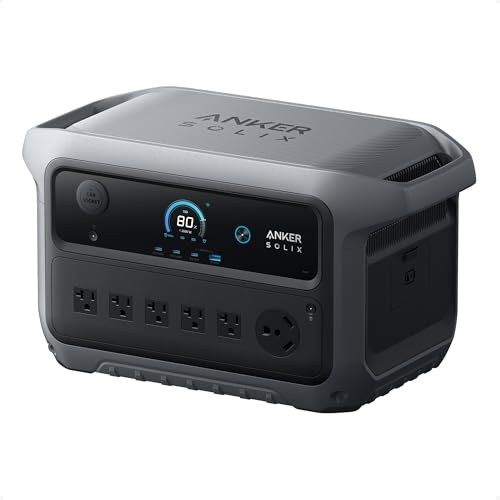 C2000 Gen 2$1,000 at Amazon
 - Easy to carry (under 30 lb)
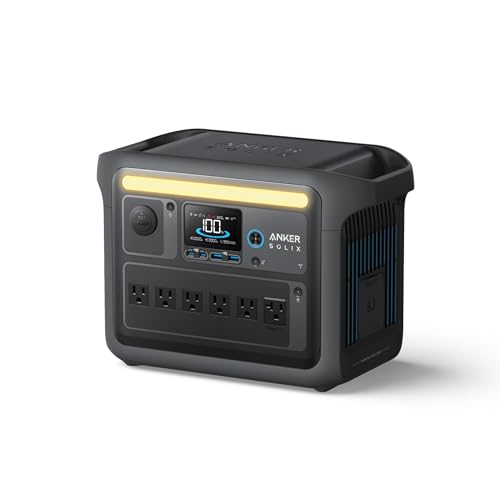 C1000$600 at Amazon
 - Keep a fridge running for a day
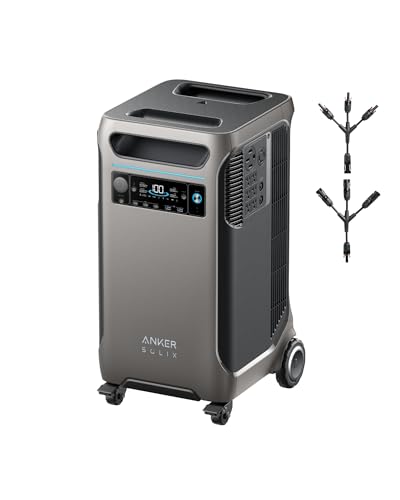 F3800$1,980 at Amazon
 - Run heavy appliances F3800$1,980 at Amazon
Each pick follows a stated rule, run on today’s prices and the maker’s figures: Lowest cost per usable kWh: the lowest Amazon price per usable kilowatt-hour today; Easy to carry (under 30 lb): the most usable battery among models under 30 lb; Keep a fridge running for a day: the lowest price among models whose usable battery covers a typical fridge for 24 hours and whose peak output covers at least the lower end of a fridge's starting draw; Run heavy appliances: the most continuous output; a tie goes to the lower price. Nothing here was tested by us.
Every Anker SOLIX power station on Amazon, compared
Anker SOLIX names are simple. C is the carry-around line; the number is roughly the battery in watt-hours (C1000 is about 1 kWh). F is the home line (F3800 is 3.84 kWh). "Gen 2" is the newer version of the same size.
| Model and verdict | Battery (usable) | Output | Wall recharge | Extra battery | UPS switchover | Weight | Amazon price | Per usable kWh |
|---|---|---|---|---|---|---|---|---|
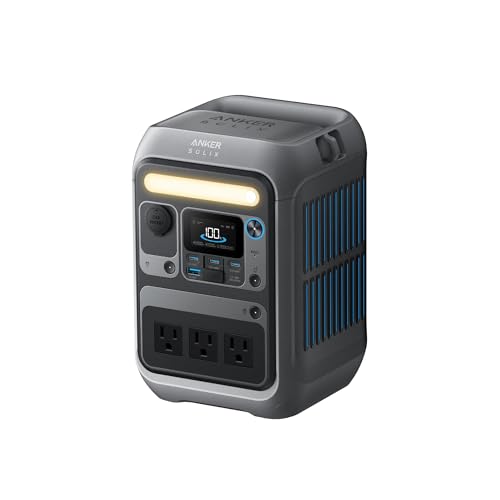 C300Buy this for phones, a laptop and a router. At 300 W it will not run kitchen appliances. C300Buy this for phones, a laptop and a router. At 300 W it will not run kitchen appliances. | 288 Wh1 245 usable | 300 W1 600 W peak | up to 330 W from the wall2 | not listed by the maker | 10 ms2 | 9.1 lb1 | $330 at Amazon | $1,348 |
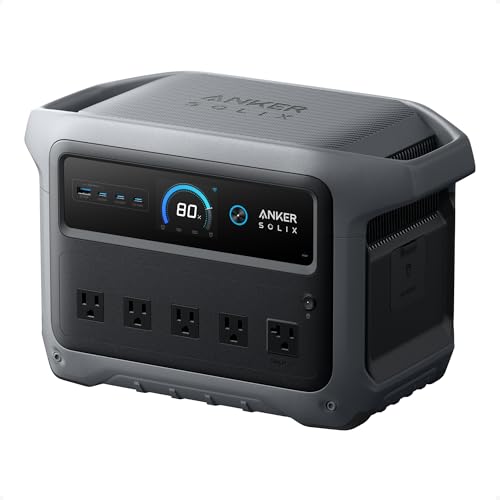 C1000 Gen 2Buy this for 1 kWh with 2,000 W and a fast full recharge. It has no extra-battery port. C1000 Gen 2Buy this for 1 kWh with 2,000 W and a fast full recharge. It has no extra-battery port. | 1,024 Wh3 870 usable | 2,000 W3 3,000 W peak | About 49 minutes for a full 0-100% recharge via UltraFast Charging4 | No expansion battery port; traded for a smaller, lighter design4 | Under 10 ms4 | 24.9 lb3 | $669 at Amazon | $769 |
| C1000The older 1 kWh model. It takes one extra battery, up to 2,112 Wh. | 1,056 Wh5 898 usable | 1,800 W5 2,400 W peak | up to 1,300 W from the wall; 0-80% in about 43 min; full charge under 1 h with UltraFast6 | Yes, one add-on battery doubles capacity to 2112 Wh7 | Under 20 ms7 | 28.4 lb5 | $600 at Amazon | $668 |
| C2000 Gen 2Buy this for 2 kWh and 2,400 W on 120 V. One extra battery takes it to 4 kWh. | 2,048 Wh8 1,741 usable | 2,400 W8 4,000 W peak | 100% in 88 min on 1,800 W AC9 | Yes, to 4 kWh with one BP2000 (Gen 2) battery9 | 10 ms9 | 41.0 lb8 | $1,000 at Amazon | $574 |
| F3800Buy this for 120/240 V and room to grow: up to six extra batteries. | 3,840 Wh10 3,264 usable | 6,000 W10 9,000 W peak · 120/240 V | up to 1,800 W from the wall11 | Up to 6 add-on batteries, 26.88 kWh added capacity12 | Under 20 ms12 | 132.3 lb10 | $1,980 at Amazon | $607 |
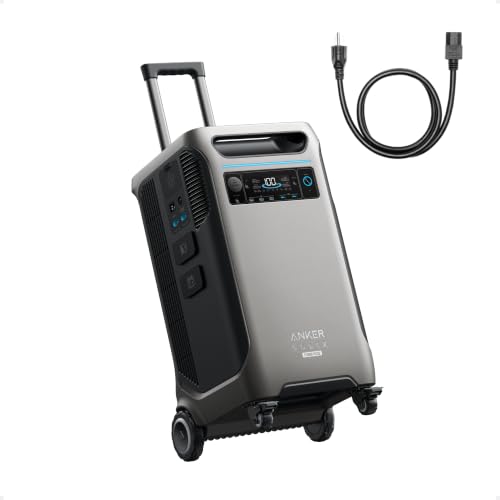 F3800 PlusSame battery and output as the F3800. Pay more only for 3,200 W of solar input instead of 2,400 W. F3800 PlusSame battery and output as the F3800. Pay more only for 3,200 W of solar input instead of 2,400 W. | 3,840 Wh13 3,264 usable | 6,000 W13 9,000 W peak · 120/240 V | up to 1,800 W from the wall14 | Up to 6 extra batteries, 26,880 Wh total capacity14 | About 20 ms UPS switchover on standard wall AC power15 | 136.7 lb13 | $2,400 at Amazon | $735 |
Usable = 85% of the battery size, the share we assume for every unit on this site. Per usable kWh = the Amazon price divided by usable kilowatt-hours. “Not listed by the maker” means the maker pages we read do not state it. It is not a zero, and we never fill it from a sibling model. Small numbers are sources, listed at the foot of the page. Prices are for the bare unit on Amazon, checked October 12, 2026; we keep no price history. Tap a column name to sort.
Small, 1 kWh or 2 kWh
The C300 is a desk and campsite unit. It holds 288 Wh and gives 300 W: enough for a router, a laptop, lights and phones, but not a kettle, a microwave or a fridge's start-up.
The 1 kWh units, C1000 and C1000 Gen 2, can start and run a normal fridge. On one charge they run a typical fridge for about 10 hours, which gets you through a night. They also run a coffee maker or a microwave for a few minutes at a time.
The C2000 Gen 2 doubles that, to about 21 hours for a typical fridge, and keeps 2,400 W of output on 120 V. Anker lists a TT-30 outlet on it for RVs. If you want one box that covers a fridge overnight and still has charge in the morning, this is the size to look at.
C1000 or C1000 Gen 2
Both hold about 1 kWh. The Gen 2 gives more output, 2,000 W against 1,800 W, and Anker says it recharges from empty to full in about 49 minutes. What it gives up is the extra-battery port: Anker says it removed expansion to make the unit smaller and lighter. If you might want 2 kWh later, the older C1000 can add one battery.
At 2 kWh, the C2000 Gen 2 does take one extra battery, up to 4 kWh.
F3800 or F3800 Plus
They hold the same 3,840 Wh battery and give the same 6,000 W at 120 or 240 V. The Plus takes more solar input, 3,200 W against 2,400 W. If you will not fill a roof with panels, the extra input does nothing for you.
Both can connect to a home panel through a transfer switch or inlet. That is a job for a licensed electrician, not a plug.
How to read the numbers
Battery is Anker's rated size. Usable is 85% of it, the same for every brand. Cost per usable kWh is the Amazon price divided by usable kilowatt-hours. UPS switchover is how fast the unit takes over in an outage: Anker states 10 ms for the C300, C1000 Gen 2 and C2000 Gen 2, and under 20 ms for the C1000 and F3800.
How long each one takes to refill from solar
Hours of full sun to put the usable battery back, at the maker’s maximum solar input and with 400 W of panels. Real panels deliver less than their rating, and a winter day has fewer full-sun hours, so treat these as the best case.
| Model | Max solar input | At max input | With 400 W of panels |
|---|---|---|---|
| C300 | 100 W1 | 2.4 h | 2.4 h |
| C1000 Gen 2 | 600 W3 | 1.5 h | 2.2 h |
| C1000 | 600 W5 | 1.5 h | 2.2 h |
| C2000 Gen 2 | 800 W8 | 2.2 h | 4.4 h |
| F3800 | 2,400 W10 | 1.4 h | 8.2 h |
| F3800 Plus | 3,200 W13 | 1.0 h | 8.2 h |
Hours = usable watt-hours / solar watts. With 400 W of panels, a unit whose maximum is below 400 W is held to its maximum.
Buying the right listing
A search for these models on Amazon returns more than the bare unit. For the 6 models above we checked 61 other listings and turned them all down: 35 bundles with panels, bags or cables; 12 accessories that name the model; 10 other models that came up in the search; 2 sibling models with an extra word in the name; 1 renewed units; 1 listings whose title did not match our figures. We link only a listing whose own title names the bare unit with our battery and output figures. Each model page lists what we turned down and why. Before you buy, match the model name on the listing to the row above.
Not in the table, and why
- F3000: Amazon's F3000 listings put 6,000 W in the title, which is its recharging figure, not its output. We link it when a listing states the output.
- F2600, F2000: No listing for the bare unit matched the bare unit by name, battery and output.
- C300 DC, C200 DC: DC only. They have no AC outlets, so they cannot run anything with a wall plug.
- C800X, S2000: Not in the makers’ figures yet.
Questions people ask
What is the difference between the Anker SOLIX C1000 and C1000 Gen 2?
Both hold about 1 kWh. The Gen 2 gives 2,000 W instead of 1,800 W and, per Anker, recharges fully in about 49 minutes. The older C1000 can add one extra battery for 2,112 Wh; the Gen 2 cannot add any.
Which Anker SOLIX can run a refrigerator for a day?
For a full day on one charge you need about 2,000 Wh usable for a typical fridge: the F3800 or F3800 Plus. The C2000 Gen 2 runs a typical fridge for about 21 hours, and the C1000 for about 11.
Which Anker SOLIX has 240 V?
The F3800 and F3800 Plus list 120 V and 240 V output. Any 240 V load or connection to your home's wiring needs an inlet or transfer switch installed by a licensed electrician.
Is the Anker SOLIX F3800 a whole-home battery?
No. It is a large portable station, 3,840 Wh with 6,000 W at 120 or 240 V, and Anker says it takes up to six extra batteries. It can run chosen circuits through a transfer switch or inlet that a licensed electrician installs. It does not replace a fixed home battery or run a whole house on its own.
Does the Anker SOLIX C1000 Gen 2 work as a UPS?
Yes. Anker states it switches to battery in under 10 ms, fast enough for most routers and computers. The older C1000 is rated under 20 ms. Plug the device into the station and the station into the wall.
Sources
Maker pages and manuals, each with the date we read it. Box contents and prices come from the Amazon listings linked above.
- ankersolix.com — c300, read August 11, 2026
- ankersolix.com — c300, read September 30, 2026
- ankersolix.com — c1000-gen2, read August 11, 2026
- ankersolix.com — c1000-gen2, read September 16, 2026
- ankersolix.com — c1000, read August 11, 2026
- ankersolix.com — c1000, read September 16, 2026
- cdn.solarpowersupply.eu — A1761_V4_EN%20(UK)_UG_Web_20241105_107299-20250512.pdf, read September 16, 2026
- ankersolix.com — c2000-gen2, read August 11, 2026
- ankersolix.com — c2000-gen2, read September 30, 2026
- ankersolix.com — f3800, read August 11, 2026
- cdn.shopify.com — A1790_V4_EN_US__UserGuide_Web_20240802.pdf, read October 1, 2026
- ankersolix.com — f3800, read October 1, 2026
- ankersolix.com — f3800-plus, read August 11, 2026
- ankersolix.com — f3800-plus, read September 16, 2026
- signaturesolar.com — Anker%20f3800%20Plus%20Manual.pdf, read September 16, 2026
Other brands: EcoFlow · Jackery · BLUETTI. All stations by cost per usable kWh: power stations. Against PECRON, Goal Zero, DJI and OUKITEL: best-value power stations across eight brands. How we size and check: methodology.
Anker SOLIX C2000 Gen 2Lowest cost per usable kWh
$1,000 at Amazon